


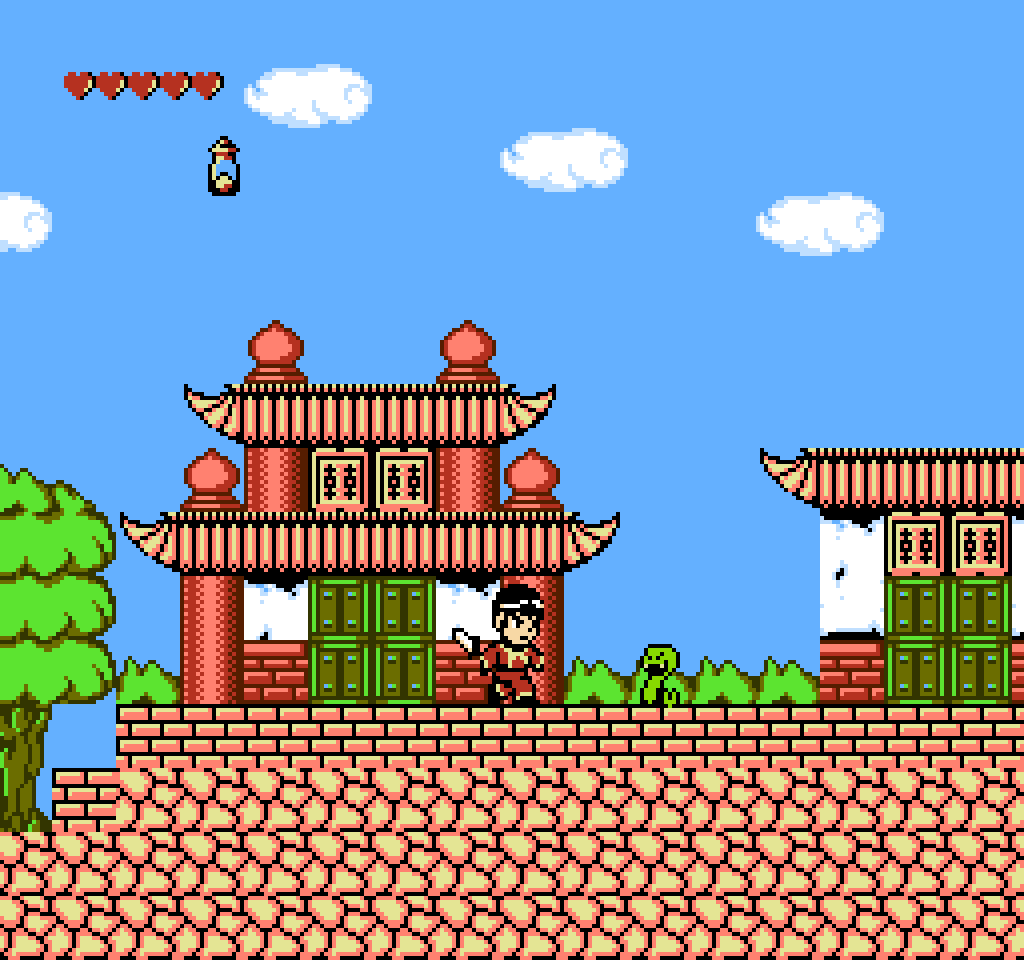
Out of curiosity, I once asked my non-gaming mother to try a few retro games. As I expected, they required a degree of skill that I’d long taken for granted. The only platformer she came close to playing well was Wonder Boy (1986) — or rather, its Nintendo counterpart, Takahashi Meijin no Bōken Jima (1988).

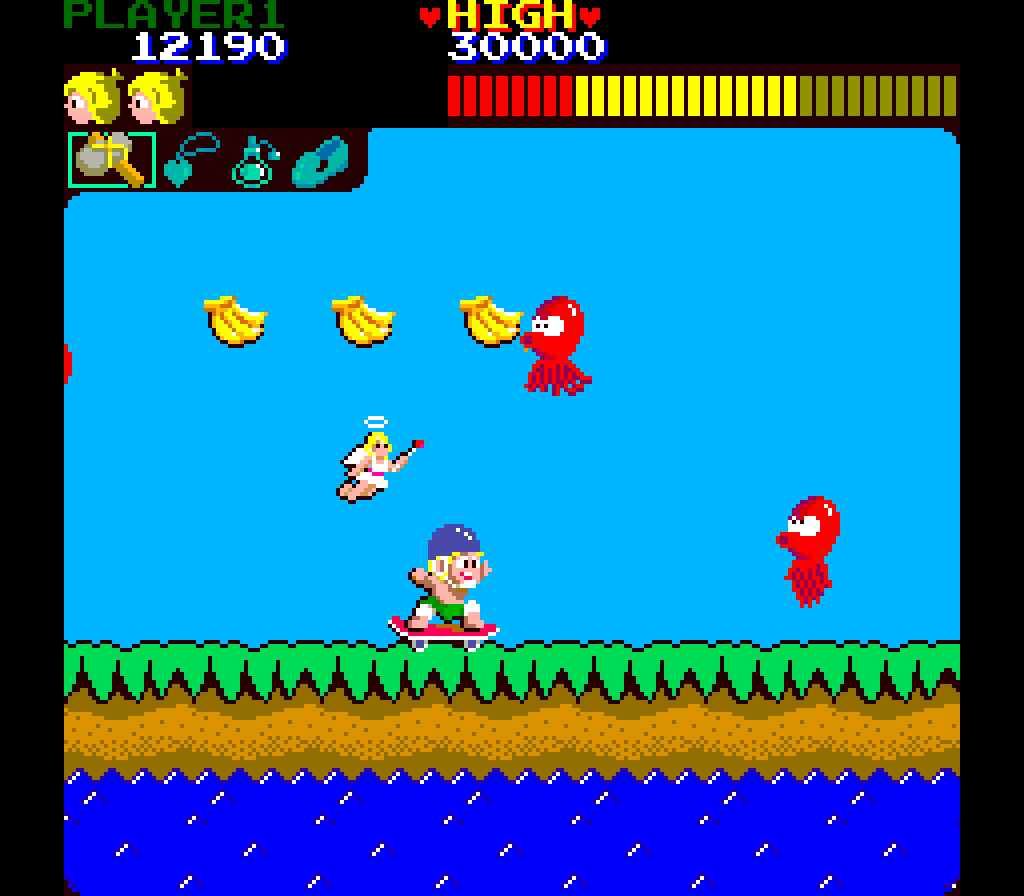
This simplicity wasn’t to last. The game’s designer, Ryuchi Nishizawa, got caught up in the RPG obsession which consumed Japan in the 80’s. His vision for Wonder Boy’s sequel would marry platforming and RPG elements, which wasn’t new for the time (see Xanadu (1985))… except this was an arcade game.

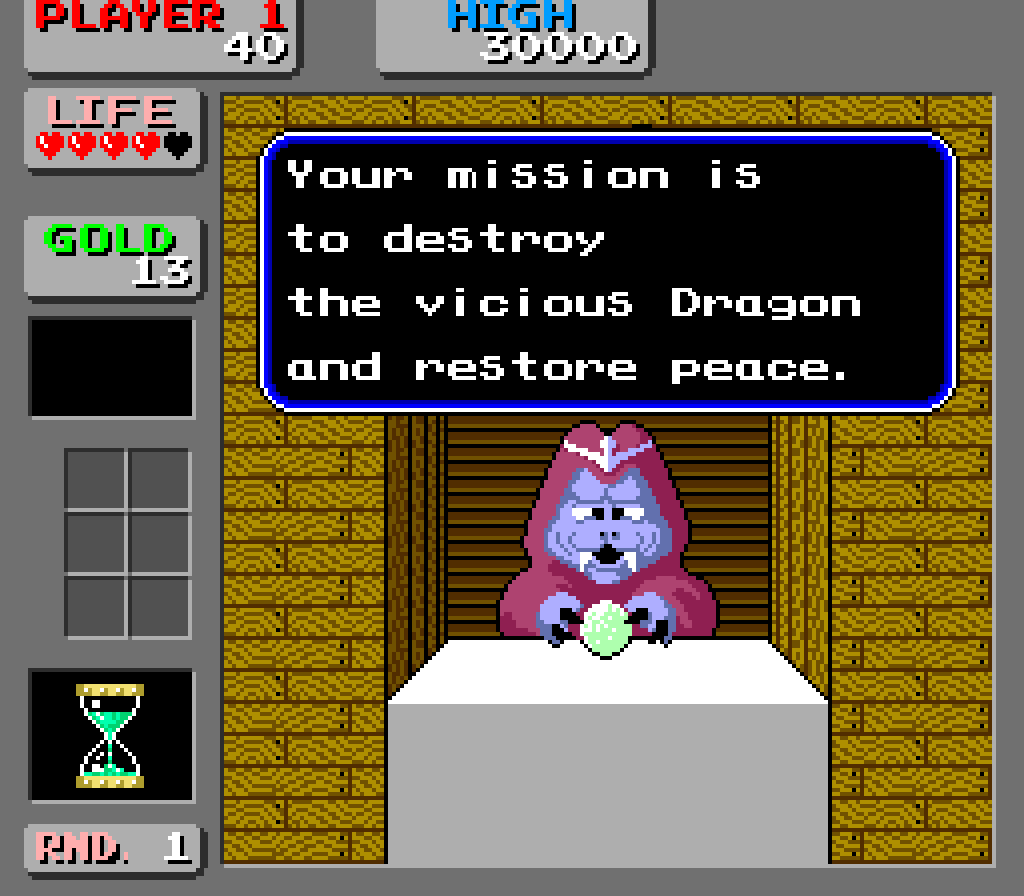
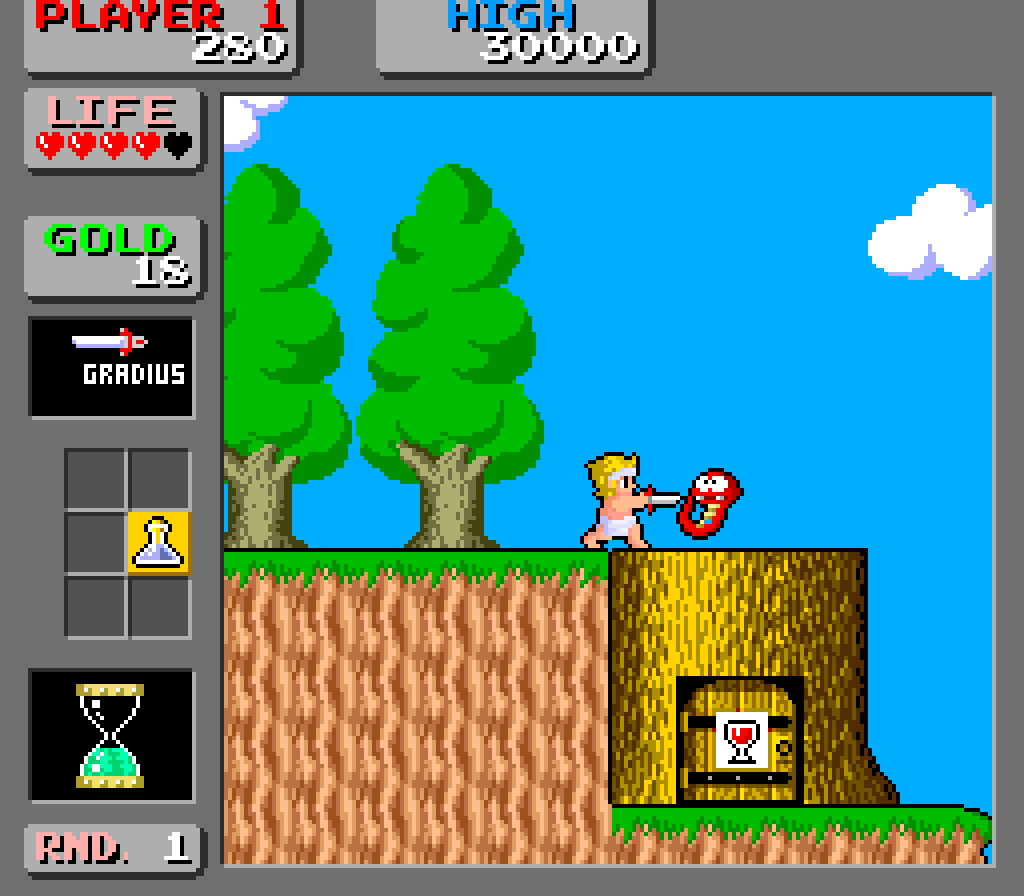
In hindsight, I have no idea how Sega okayed this. You want arcade games to be played in short bursts so the coins keep flowing, but a session of Wonder Boy: Monster Land could last close to an hour.
As it turns out, Nishizawa was on to something: you could simplify an inventory system enough that it requires no explanation. The functions of Monster Land‘s items are intuitively understood. They’re also obtained fairly quickly, so it’s not a huge deal when it’s all gone…

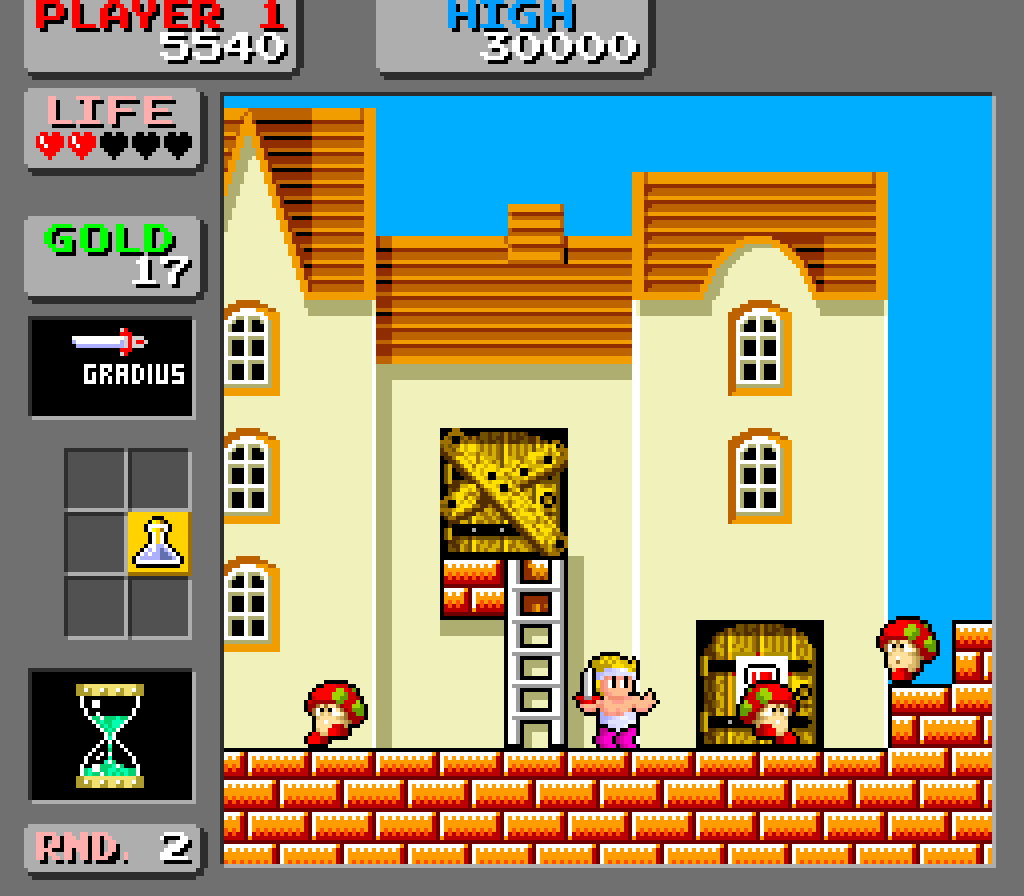
… is what I’d like to say. The truth is that acquiring gear has to be carefully optimised if you want to stand any chance in the game’s later areas. That means foregoing upgrades for a while to afford better ones, and there may be long stretches between shops.
The game has limited currency per area, so grinding is not an option. Instead, you’ll want to slay everything and scour every corner. The values are always slightly randomised too. There is a technique to produce more money by shaking the joystick, but I’m unsure if this design was intentional.
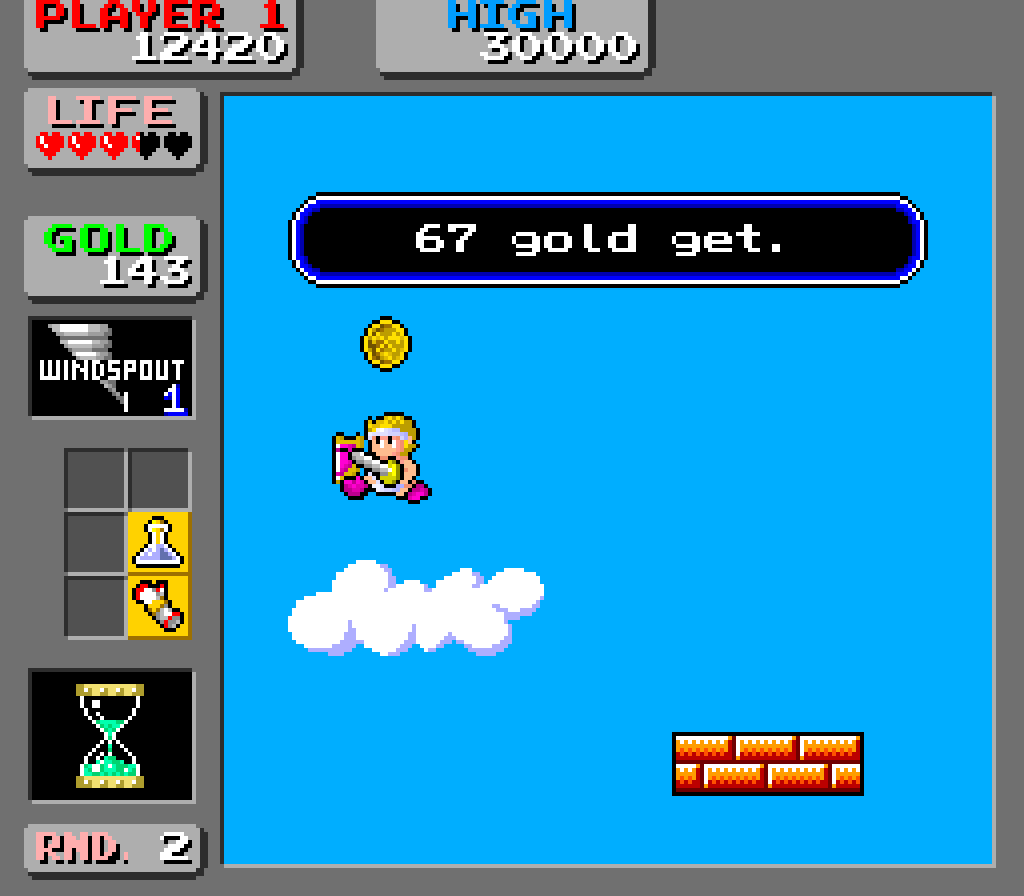


There isn’t much of a story: you are Bock Lee Temjin (what a name) and you’re here to end a dragon’s reign of tyranny. Not much to say there, so let’s move on to the game system.
There are two buttons: jump and attack. Magic spells are performed by moving the joystick down, which is a little weird. There are a few other items but those either provide passive benefits or are used automatically.
There are four equipment slots and upgrading them has various effects:
- Sword — Increases damage
- Shield — Deflects projectiles
- Armour — Increases defence
- Shoes — Increases speed and jump height


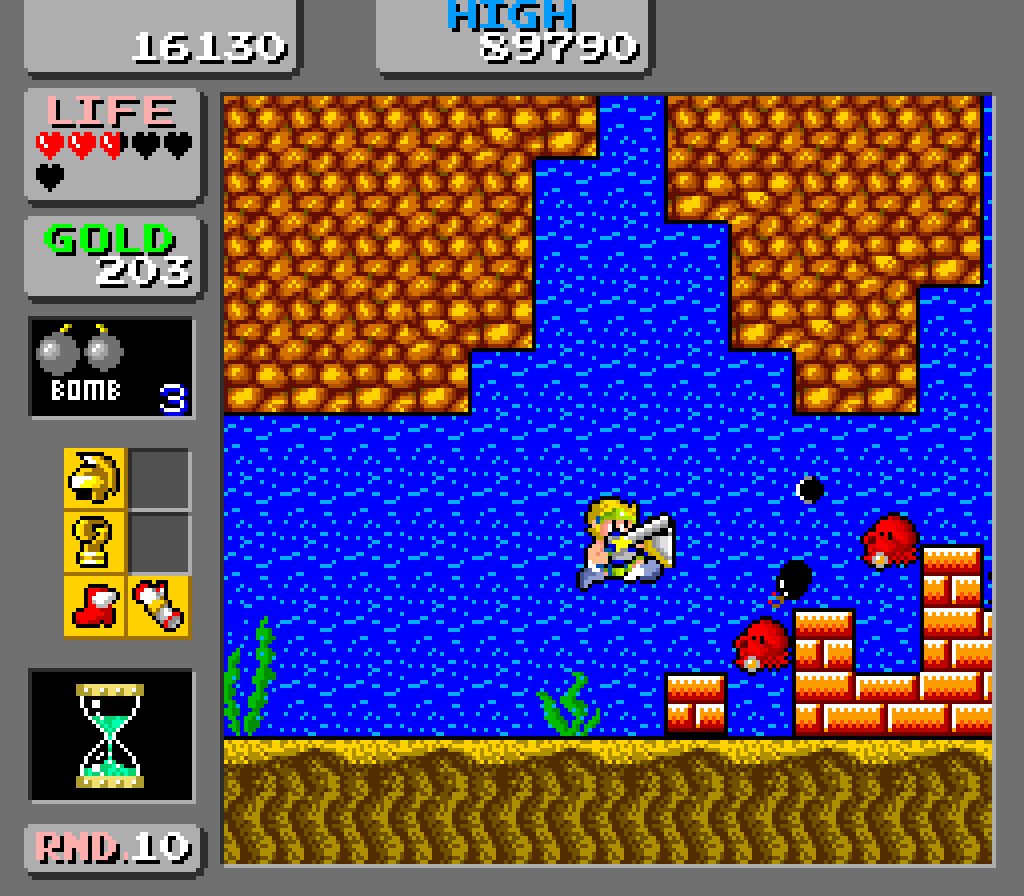
You can also pick up the following items:
- Gold — For buying stuff
- Fire Spell — Homes in on a target
- Bomb Spell — Rolls along the ground and explodes
- Tornado Spell — Bounces off of walls and enemies
- Lightning Spell — Hits everything on-screen
- Potion — Restores 5 hearts before death
- Helmet — Doubles defence (breaks eventually)
- Gauntlet — Doubles damage (breaks eventually)
- Winged Boots — Lets you float in mid-air
- Cloak — Grants temporary invincibility
- Quest Item — Trading these with various NPCs will provide a special item before the game’s end
- Treasure — Gives points, which grants an extra heart at certain milestones
- Key — Opens doors, obviously
Besides gold, there are no numerical stats or damage values; everything is represented through hearts and changing colours. It’s not dissimilar to The Legend of Zelda (1986) in that regard and lends itself well to an arcade setting.

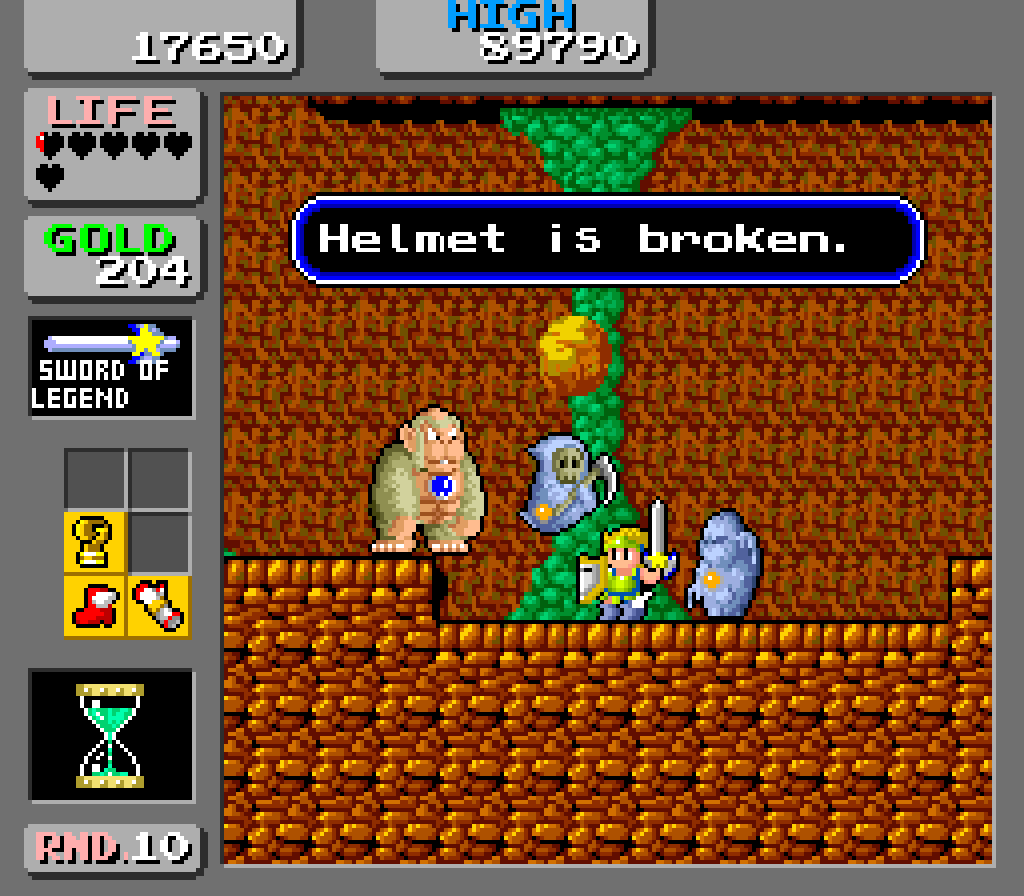
Monster Land succeeds at making you want to reach further each time. When you come close to beating a boss, you might say ‘Dang it! If only I had done that thing earlier!’, encouraging you to manage yourself better next time.
This is a game which is just as fun to watch as it is to play. The combination of strategy and mechanical precision creates an experience quite unlike anything else I’ve ever seen in an arcade game. The closest I can think of is Magic Sword: Heroic Fantasy (1990). It’s a shame there aren’t more games like this, even today.


The original version of Monster Land would only be officially released in English years later for the Wii’s Virtual Console. Before that, an English bootleg version with hilarious dialogue floated around for a time.
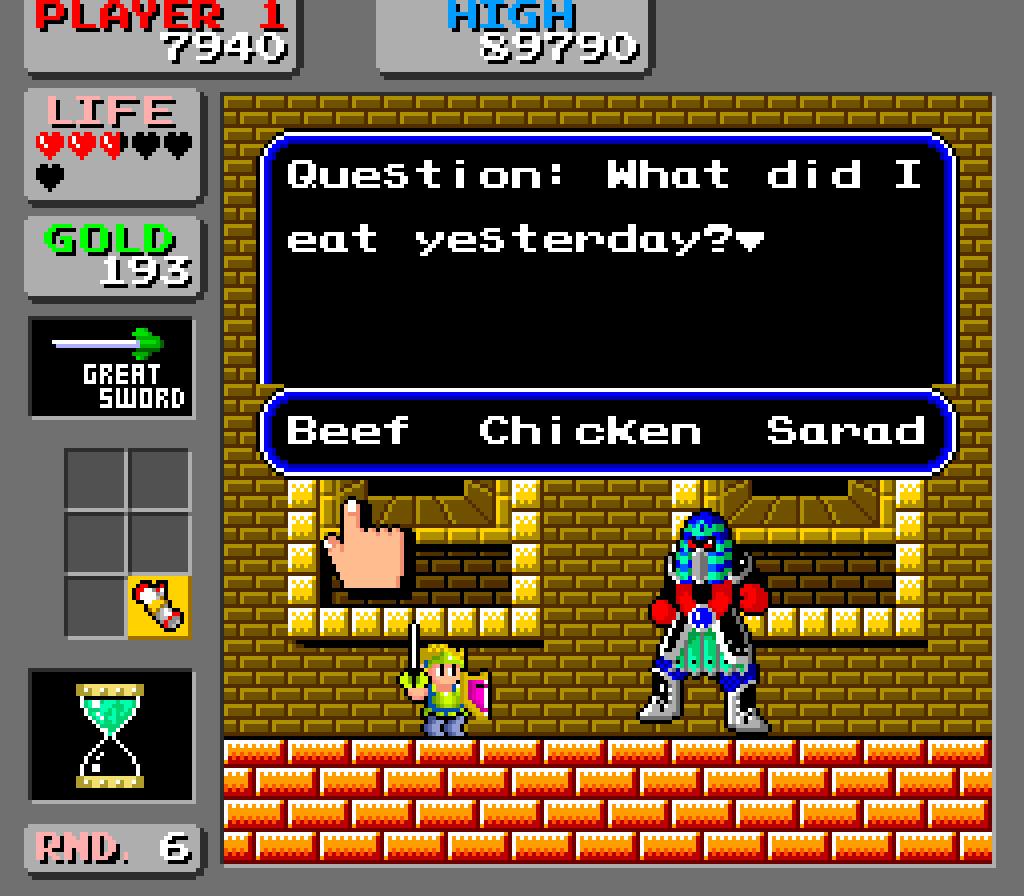
This makes one particular boss even funnier: the Sphinx can be skipped entirely if you answer his riddle correctly. The answer is always random and must be learned by asking a bartender. Not only are the bartender’s lines awkwardly worded, but the Sphinx’s responses are just as badly written.

There were many home-console versions, all with different titles and character graphics. As was the case with Wonder Boy, Sega owned the character but not the game, so only the Master System port remained somewhat faithful. The PC-Engine port is based on Bikkuriman, a line of wafer snacks that spawned an anime adaptation which, remarkably, is still running as of 2023.
No, I’m not going to mention the Brazilian version. Some things deserve to be forgotten.
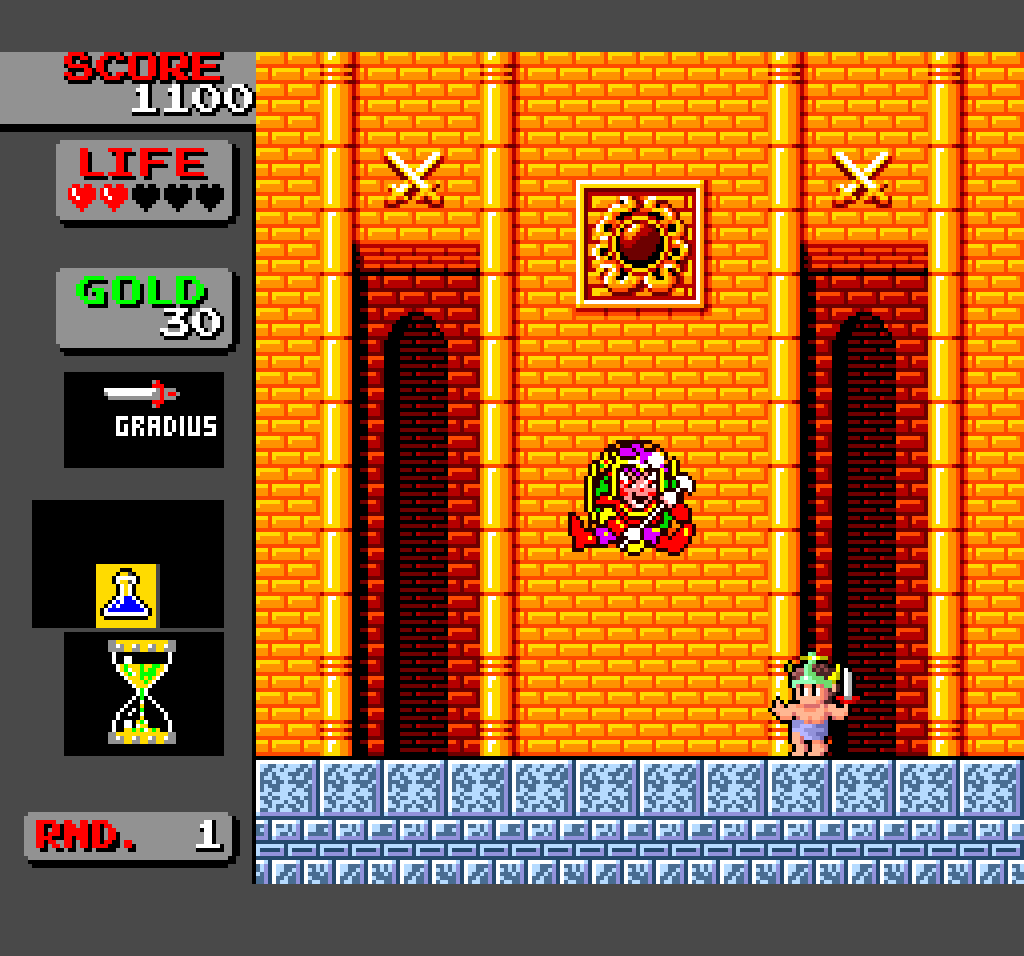

Wonder Boy would have many sequels and there are three of note for their similarities to Monster Land: Wonder Boy III: The Dragon’s Trap (1989), Wonder Boy V: Monster World (1991) and Monster World IV (1994). The first of those is considered by many to be one of the best games ever made.
There were plenty other games but I’m going to end the look on its legacy here, as many of them deserve their own retrospective. This game series really deserves more recognition than it gets. We’ve been seeing remakes of them as recently as 2021, proving that they’ve left an impression on those who experienced them.


Okay, this is it. I’m gonna kick that dragon’s ass. I didn’t do any of the sidequests but surely I’m good enough to—I RAN OUT OF TIME? ARE YOU KIDDING ME?!

