


In 1988, an eye-catching, stomach-churning game arrived in arcades; Namco’s Splatterhouse (1988) was unlike anything we’d ever seen… well, almost anything (see Chiller (1986)).
Its development team wondered — rightly so — why graphic depictions of violence were acceptable elsewhere, but not in video games? Sensing new ground to tread, they set out to make a sincerely unsettling game. There were still a few restrictions imposed but for the most part, this was the first instance of digitised gore that most gamers laid eyes on.


It was generally well-received, with criticism aimed mainly at its brevity and relatively simple gameplay. Beyond the gruesome novelty, there isn’t a great deal of depth. It’s a coin-muncher through and through, more easily conquered by memorising enemy patterns than by demonstrating any real skill.
The titular Splatterhouse is West Mansion, former domicile of the recently deceased Dr. West — an obvious reference to Herbert West–Reanimator (1922). A couple named Rick and Jennifer take refuge from a storm, only to be attacked by monsters. Jennifer goes missing and Rick is killed… but wait! He is then resurrected by the “Hell Mask”, which transforms him into a vengeful, hulking brute.

The game contains several indiscrete homages to popular horror movies: the most obvious being Friday the 13th (1980), but also The Evil Dead (1981) and The Texas Chain Saw Massacre (1974), among others. The game is well known for a moment where Jennifer turns into a monster and Rick must put her down, all while she cries for help.

No way would Nintendo allow something like this on their systems, so it’s unsurprising that Splatterhouse’s first console entry arrived in the form of Splatterhouse: Wanpaku Graffiti (1989), an adorable self-parody.
It would be a few years before Mortal Kombat (1992) actually caused a media stir with its “lifelike” characters and fatality moves. It was in that very same year that Splatterhouse would properly return, beating Mortal Kombat to the Sega Mega Drive.
So why am I covering Splatterhouse 2 in detail instead of the original? Honestly, I just like this one better.


The sequel was developed by Now Production, a frequent Namco collaborator. You’d be forgiven for assuming the two games shared the same team as they are stylistically similar. That said, the story and general premise were thought up by Atsuhiro Hayakawa, a producer on the first game.
Now Production handled both Splatterhouse 2 and Splatterhouse 3 (1993), which began development before 2 was completed. The team had previously worked on Yōkai Dochuki (1988), a more lighthearted spooky game, so this wasn’t completely unfamiliar territory for them.
The game’s haunting opening crawl tells you all you need to know: Rick has fever dreams of Jennifer’s soul lost in darkness. The mask informs Rick that she is not yet dead and that he must “go back to the house”. Rick dons the mask once more to undo his greatest regret.


The Japanese opening is a little different, explicitly mentioning that this is a different house, whereas the English version suggests that this is the same house. That would be a little strange since we saw it burn down in Splatterhouse… also you can see its ruins in the opening… also its ruins are literally Stage 1.
Here’s a direct translation of the original manual:
恐怖のストーリー
ジェニファーを救うため、リックは“隠された館”へ…。
あの惨劇から3ヶ月。リックは恋人ジェニファーを救えなかったばかりに、悪夢に悩まされ続けていた。そんな彼の目の前に、あの忌まわしいヘルマスクが再び姿を見せた。
「ヘルマスク…。それは“悪魔の魂を宿し 過去あまたのものに力を与えし仮面。あの悪夢の引金をひきし呪わしき仮面である。“ジェニファーは死んではいない。汝、彼女を助けたければ、あの呪われし場所を再び訪れるのだ。そして、“隠された館”を捜すのだ。館にたどり着けば、すべての魂を解放する “冥府の秘鍵”を見つけられるだろう。さあ、再び我が力を貸そう。お前がそれを望むならな!」
リックの脳裏をすべての過去が通り抜けた。もはやリックにはジェニファーを救い出すことしか見えていなかった。そして、その古代の仮面をゆっくりと自分の顔へ押しあてた…。
The Terrifying Story
To save Jennifer, Rick heads toward the “Hidden Mansion”…
Three months have passed since the tragedy. Rick has been tormented by nightmares of being uanble to save his beloved Jennifer. One day, the dreaded Hell Mask appeared before him once more.
The Hell Mask… a mask imbued with the soul of a demon, which granted power to its many past wearers. It is the very mask that turned Rick’s life into a nightmare.
‘Jennifer is not dead. If you wish to save her, you must return to that accursed place and search for the Hidden Mansion. Once you reach it, you will find the Secret Key to the Underworld, which can free any soul. Come, I will lend you my power once again, if that is what you desire!’
Rick’s mind was flooded with memories of the past. He could think of nothing now except rescuing Jennifer. Slowly, he pressed the ancient mask against his face once more…
The manual contains a few delightful descriptions of the monsters. For example, the common “deadmen” enemies are the melted remains of the zombies from the previous game. Lovely.
It also has these awesome illustrations:
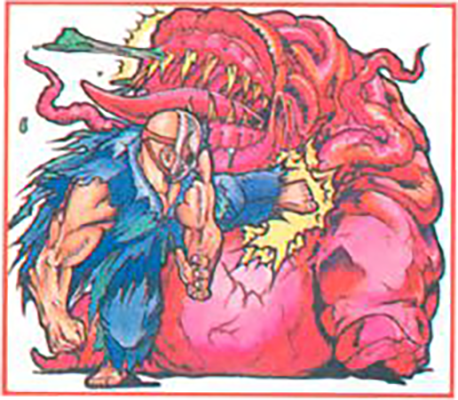
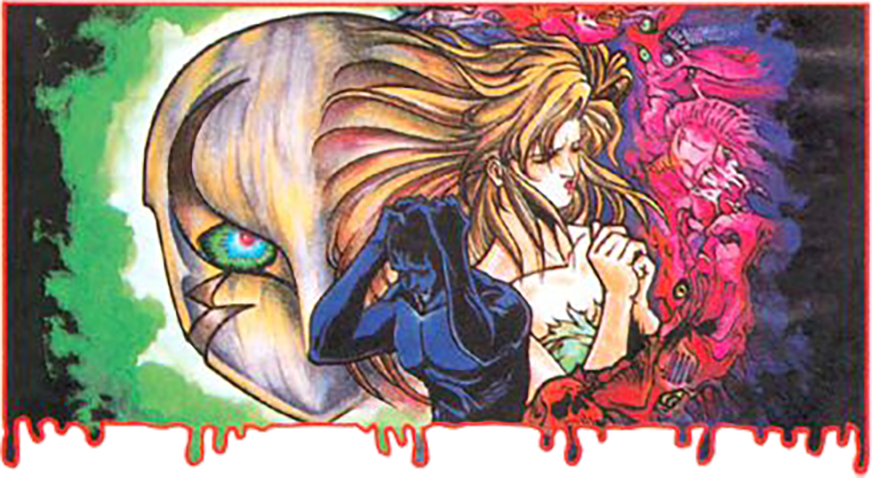

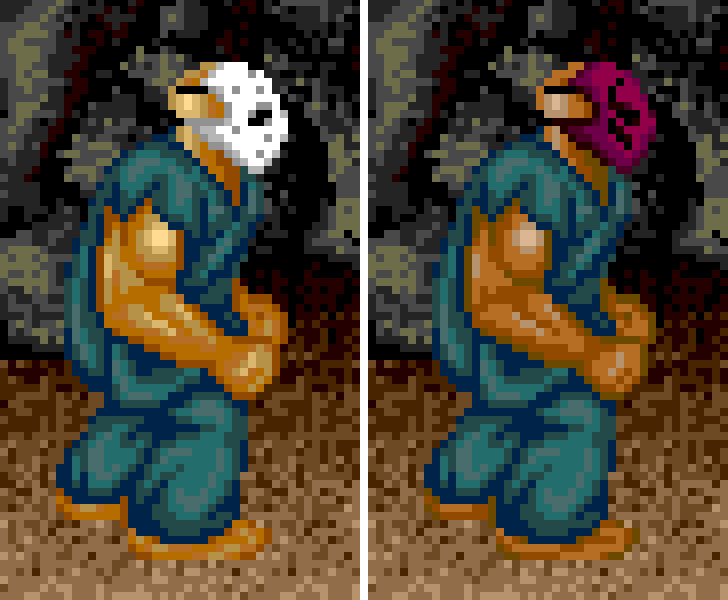
The original Splatterhouse‘s home release had some regional differences. Primarily, the mask was given a garish red colour to make it more lawyer-friendly. The Japanese version of Splatterhouse 2 gave the mask a serpentine kabuki look, while the Western version went for a more generic skull face. I think the third game nailed the mask design and it’s a shame that we didn’t see it here.


The fundamental gameplay hasn’t changed much. It’s still a two-button affair: jump and attack, plus a hard-to-perform sliding kick. It’s a little snappier though, with jumping kicks not halting your momentum as much.
Splatterhouse 2 is also a little more generous than its predecessor. The Japanese version does not have the Western version’s password system, although there is a stage select code. There are some minor balance changes between the two, but the core experience is largely the same.


Unlike the previous game, there is no devilish mist to make you its plaything if you idle too long. On the whole, I’d say this game encourages a slower, methodical approach, which is probably why I prefer it.
The bosses are a standout for me, being far more interesting than the ones from Splatterhouse. The sprites are larger, the attacks are less cheap, and they all have unique death animations. One of them looks suspiciously like the Beast from Poltergeist (1982).
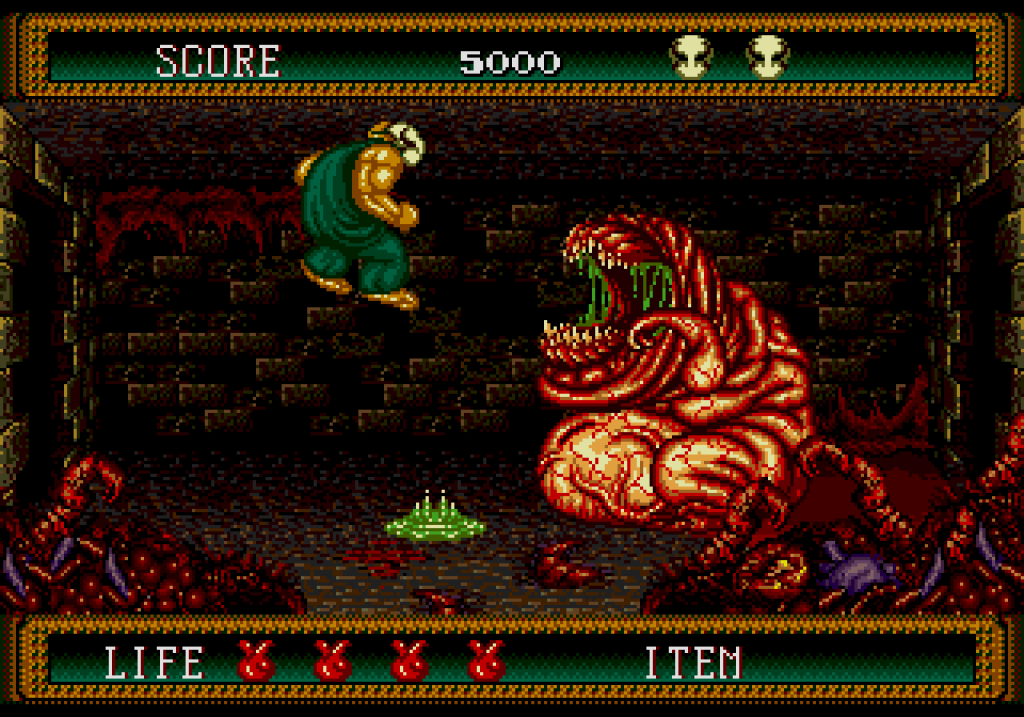


When you finally reach Jennifer and release her soul from its crystalline prison, it turns out that tampering with the borders between worlds has unsealed the “Servant of the Loathsome Gods” (忌まわしき神々のしもべ). After fleeing the mansion, you must banish it… with your fists, naturally.
Although Rick manages to escape with Jennifer, I think an Orpheus-style ending would’ve worked better; after all, her body was still destroyed in Splatterhouse. Being momentarily reunited with her and saving her soul would’ve been more in line with Splatterhouse’s bleaker story.
Still, the Mask does mention that Rick’s breaking of the “seal” will have consequences, which may have been its motivation all along. The face rising from the lake looks a lot like Dr. West’s spirit (I assume it was Dr. West) from the previous game.


Now Production could have easily phoned this one in, so I appreciate the effort. The music by Eiko Kaneda is especially awesome. They would be far more experimental with the third game, but it’s nice that they wanted to “get it right” before tinkering with the formula.
Splatterhouse 3 was developed with Western players in mind and plays like a belt-scrolling beat ’em up. It is fun but its stages are more repetitive and enemy behaviours are less interesting. The cutscenes, which were created with local actors and paper clay models, are a nice touch.
Oh, and there was a 3D game in 2010, directed by someone who didn’t care for the IP and had it wrested from him before completion. The salvaged product is mediocre and wasn’t even released in all territories. It does feature Jim Cummings as the Mask, though.


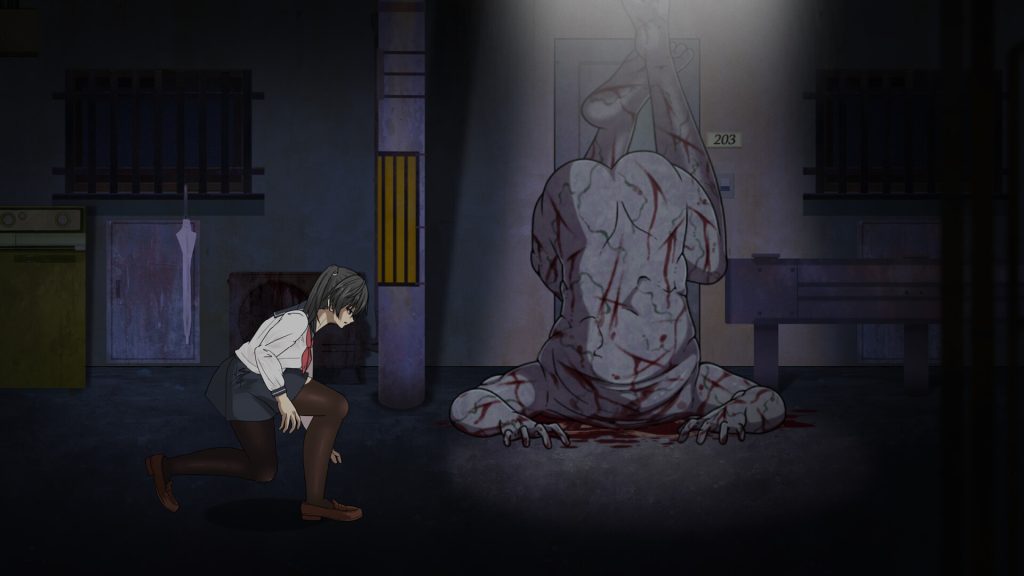
Splatterhouse’s legacy is infamous among Japanese doujin games, many of which have been inspired by it. Unfortunately, most of them are too grotesque or perverse for me to mention here. The style lends itself well to a particular kink which I’m reluctant to talk about, but I’m sure you can use your imagination.

Man… that original manual sure was cool, wasn’t it? Why don’t we take a look at the English ma—oh my god, why did this keep happening? It’s like we were on a quest to ruin any artistic integrity video games had.


Whoever wrote the English copy invented a character named Dr. Mueller, who discovered the mask in a Mayan temple — hey, I’ve heard this one before — and gone are the cool descriptions of all the enemies, bosses and stages. Why does it refer to score and lives as “Dastardly Data”?
Sigh. Anyway, much love to Rob of West Mansion, whose passion for this series has kept it alive.
