

Note: Special thanks to Aeon Genesis for the translated images of Shin Megami Tensei.
Wizardry: Proving Grounds of the Mad Overlord (1981) forever altered Japan’s pop culture. Wizardry is to Japan what David Hasselhoff is to Germany. Before long, everybody wanted to make a blobber (a term for Wizardry-likes).
Less popular but still modestly successful were the Digital Devil Story novels by Aya Nishitani. Their publisher was no stranger to approaching anime and game companies to expand their IPs, already seeing success with novels like Dirty Pair (1980).


Atlus created Digital Devil Story: Megami Tensei (1987), a blobber with one distinguishing feature: the ability to recruit enemies. It’s here that we can trace the beginnings of the “monster catching” subgenre, now popularised by a certain highest-grossing media franchise of all time.
Its success led to a sequel, Digital Devil Story: Megami Tensei II (1990), and several cornerstones of its subsequent series can be found here: demon fusion, lunar phases, Tokyo in ruins, and many monster designs — including eventual series mascot Jack Frost.


No longer wanting to split the profits with the novel’s publisher, Atlus bought the Megami Tensei trademark — the subtitle of the first novel, meaning “Goddess Rebirth” — and used this name for all future games the same way HBO used Game of Thrones. It’s here that we arrive at the first game completely divorced from the source material: Shin Megami Tensei (1992).


Shin Megami Tensei feels much like a remake of Megami Tensei II, or more accurately, it feels like Megami Tensei II at its full potential. The story begins the same way the others did: humanity discovers that computer programming code and demonic incantations share structural similarities. This opens the door between worlds, leading to all sorts of chaos in Tokyo.
Well, not just chaos. While the forces of chaos are commanded by Lucifer, the lawful opposition is led by YHVH, the God of the Old Testament. If you assumed that God and his angels were the good guys, you’d be wrong. All demons (a term used here for any supernatural entity) have their own agenda and Earth merely serves as the battleground for their cosmic politics.


The game opens on two dream sequences where you meet your future companions: a chaos-aligned hero, a law-aligned hero and a neutral heroine who belongs to neither. You can name them and yourself, although you will always be assumed to be male.


You then wake up to find a mysterious email attachment that allegedly allows you to summon demons. Rightfully ignoring this, you carry on with your life, eventually returning home just in time to get arrested for murder. Huh?!
Once you realise that you’ll be used in human experiments, that demon summoning program suddenly seems quite useful. After breaking out, you learn that things have gotten very messy outside, with the USA coming down on Japan for not stopping the demonic invasion.


Before I spoil the whole story, let’s talk gameplay: combat is turn-based and you can allocate stats to your characters, although your player character will never learn magic — a trade for being able to summon demons. Your team can hold six members composed of yourself, human allies and demons.
Human characters can equip both melee weapons and firearms, with the latter being useful for hitting multiple enemies. Annoyingly, equipment is separated by gender, with no logic offered as to how or why. Given that most characters are male and the sole heroine isn’t always available, this can be very frustrating.


Recruiting demons is done via negotiation. You have to accurately guess what sort of response they want to hear, and possibly barter with items and money too. Demons have a limited capacity for growth, requiring you to fuse them into new forms. For whatever reason, keeping demons on the field consumes a resource called magnetite.
Demons are not limited those of Christian origin; every world religion, mythology, cryptid or urban legend also gets invited to the party. Most designs were handled by the legendary Kazuma Kaneko, whose imagination is on full display.


The game’s rhythm is exactly what you’d expect: receive a quest, explore a dungeon, rinse and repeat. Fortunately, Shin Megami Tensei has several quality of life features, including a map and an autobattle mode. Its UI hasn’t changed much since the 8-bit games, however.
⚠️ SPOILER WARNING ⚠️
Okay, back to the story: a reactionary militia arises as a response to the USA declaring martial law. Whether you choose to side with the partisans or the American ambassador (actually the Norse god Thor in disguise), the US launches missiles towards Tokyo, and the heroine sacrifices her life to save you and your friends.


This marks a significant turning point: thirty years pass and now the whole world has fallen into ruin. Your radicalised friends have taken opposing sides in the conflict, either serving heaven or hell. This whole section feels like the biblical endtimes, with humanity scrambling to build a tower before God floods the world.
True to the game’s title, the neutral heroine resurrects in a new body. From this point on, your choices teeter you towards one of three endings — law, chaos or neutral — and once the flood begins, there’s no turning back. Achieving the neutral ending requires careful balancing or playing a minigame in Disneyland Destiny Land.


The neutral path is also the hardest, requiring you to defeat both YHWH and Lucifer’s representatives (the head honchos themselves are disappointingly absent), as well as both of your old friends. It ends on a promise of a world you’ll never get to see. Sorry, power-of-friendship enjoyers; Shin Megami Tensei only offers bittersweet endings.
END OF SPOILERS
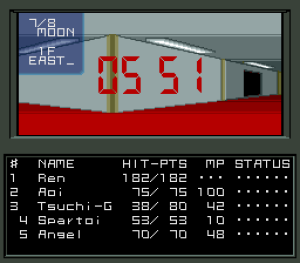
As fascinating as this all is, the game still has a lieu of problems. Being a 2D blobber, backgrounds repeat themselves, making it easy to get lost. The world maps are also less interesting than the ones seen in Megami Tensei II, despite introducing the now-familiar navigation icon. Worst of all is that you can’t see anything in a dungeon unless it’s directly in front of you.
The balance isn’t great, either; a bit past the halfway mark, you can avoid most fights and still handle the bosses without much trouble. In fact, it often makes sense to do so, since regular enemies are sometimes tougher than the bosses, just with fewer hit points.
Shin Megami Tensei had many ports and remakes. Yet, only a single one — the worst one, in fact — was ever released outside of Japan. Considering how important this game is to the medium as a whole, this is a truly baffling decision on Atlus’s part.


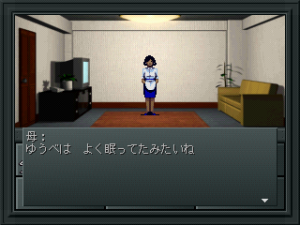

True to its nihilistic approach, Shin Megami Tensei II (1994) doesn’t follow the “best” ending, instead depicting a future where YHWH won. This would be the last game in that canon, with the many, many sequels and spin-offs all taking place in different continuites.


I won’t talk about all of them or we’ll be here until the actual apocalypse. There are a couple of games worth mentioning because they run on the same engine as Shin Megami Tensei.
The first is Shin Megami Tensei: if… (1994), released only seven months after Shin Megami Tensei II. This is a fascinating game; it’s shorter but very non-linear, allowing for repeat playthroughs. if… (named after if… (1968)) would be the first game explicitly depicting high-schoolers and has a tangential connection to Shin Megami Tensei‘s most popular spin-off. You know the one.
The second is Kyuuyaku Megami Tensei (1995), a remake of the first two games. I’m not sure how Atlus managed to negotiate this with the Digital Devil Story publisher but I’d love to know. This version adds extra content to both games, making it the best version to play.


Given its religious themes, there was no way in hell (heh) that 90’s Nintendo would allow the game to be localised abroad. A shame because it explores interesting ideas that we wouldn’t see in gaming for decades to come.
You’d think this series would be hugely popular today but Megaten (fan abbreviation) has never been a hot seller. Atlus has struggled to keep the mainline games relevant, having tried anime aesthetics and moe character designs to garner appeal — a bizarre choice for a series defined by its maturity.
Personally, I’d love to see Atlus lean further into its horror and sci-fi roots. With a seasoned author in that space, like Yusuke Kishi or Toh EnJoe, and smart marketing, they could deliver an unforgettable mid-budget game. The potential is still there; it just needs a strong creative direction to bring it to life.

Have a few more screenshots because the game’s just so darn gorgeous:


