

Lucasarts really found their rhythm in the early 90’s, releasing classics like The Secret of Monkey Island (1990) and Day of the Tentacle (1993). All of these titles were built on the SCUMM engine, a scripting system originally developed for Maniac Mansion (1987).
Among the studio’s standout artists was Steve Purcell. He was a cartoonist who had a habit of sneaking his own creations, Sam and Max, into the backgrounds of different games.


Well, to say Steve created Sam & Max is a bit of stretch. They were actually the childhood inventions of his younger brother, Dave. The story goes that Steve teased Dave by drawing the characters in increasingly strange scenarios filled with overly wordy dialogue. Eventually, Dave gifted full ownership of the characters to Steve.


Sam and Max are a duo of semi-anthropomorphic crime fighters who refer to themselves as “freelance police”. They’re basically private detectives with far fewer ethics. They are the good guys… but only just.
The dog, Sam, is inspired by Humphrey Bogart’s detective characters. He’s the more level-headed of the pair, though he still has a mischievous streak: he loves to stuff his face and has a penchant for criminal recklessness. His berserk button is seeing Max get hurt… or having his belly slapped.
Although inseparable from Sam, his leporine companion Max is often treated as the series’ mascot. Max is a creature of id and relishes in chaos. You might assume that makes him one-dimensional, but Max breaks every rule, including that one; he has a surprisingly extensive vocabulary and a remarkable amount of specialised knowledge.


Steve produced Sam & Max comics sporadically throughout the ’80s, later compiling them into Sam & Max: Surfin’ the Highway (1995). Although the duo have since appeared across various forms of media, this tome still functions as the definitive guide. You can find all the classic Sam & Max tropes here, from their association with rats to the running joke that Max “doesn’t even like girls.”
Maybe it was because their style of humour fit neatly with LucasArts’ own house style, or maybe it was simply because securing the rights was straightforward, but Sam and Max ended up with a SCUMM game of their very own: Sam & Max Hit the Road (1993).


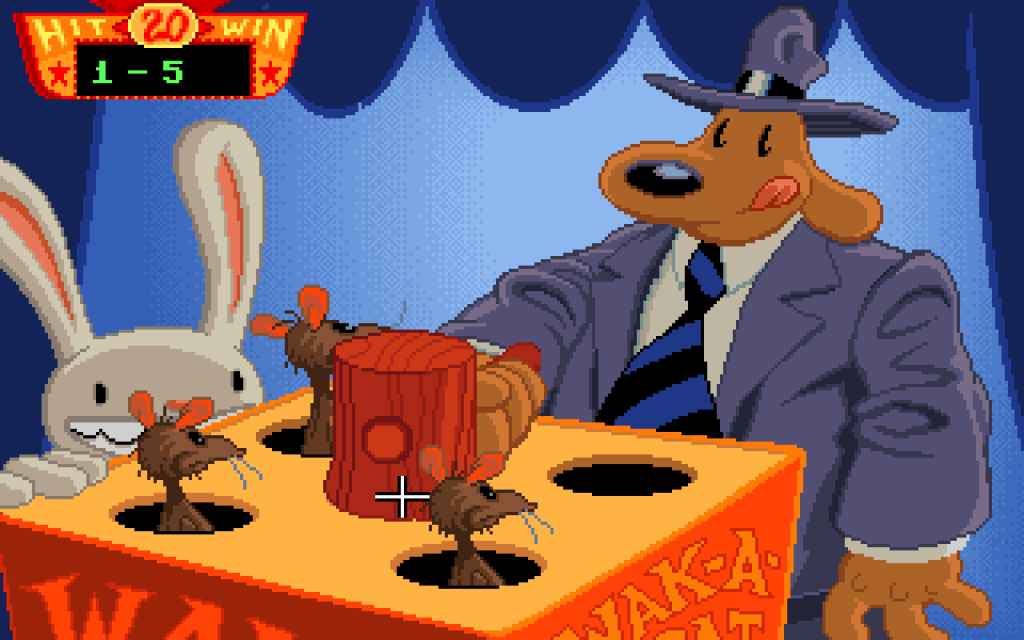
All SCUMM games (with the exception of Maniac Mansion) follow a similar design philosophy: no dead ends and no player deaths. This was likely a response to the largest criticisms of LucasArts’ main competitor, Sierra, whose games were infamous for both.
Does that mean LucasArts’ games were devoid of frustration? Ha ha. No.


Perhaps to pad out the playtime, though more likely to drive players towards the premium hint line, the puzzles in these games often require ludicrous leaps of logic. In their more grounded titles like The Dig (1995), you can usually justify the solutions with a bit of thought, but in a cartoon universe like Sam & Max? Good luck.
Here’s one example: to retrieve a mole man’s treasured mood ring, you need to combine a broken golf ball retriever with a fish-shaped magnet and Jesse James’s severed hand. Yeah.

You may be wondering what kind of bonkers story justifies a task like this. In this adventure, Sam and Max are dispatched to tourist traps across the United States in search of a carnival’s missing Bigfoot. Along the way, you’ll visit such delights as the “World’s Largest Ball of Twine” and the “Celebrity Vegetable Museum”.
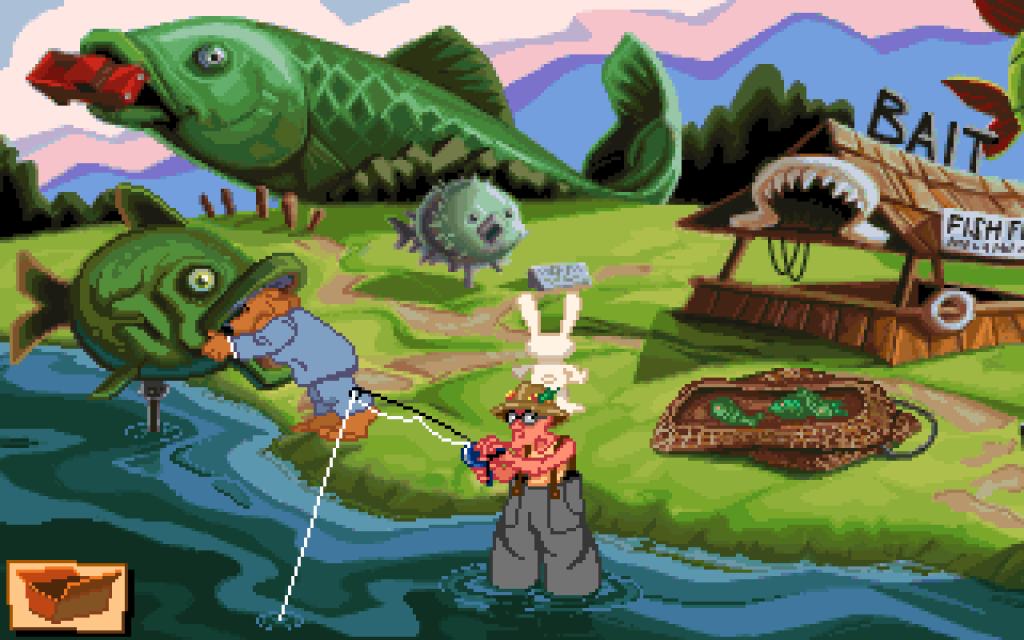


The sheer variety of locations and their unique features make reaching new areas genuinely exciting. The game is fully voiced, and the banter between the two heroes is a joy to listen to. You only ever control Sam, the duo’s designated thinker, but the pair still feel like a package deal.
It wouldn’t be a detective story without a few twists and turns, and while this game doesn’t deliver them in Sam Spades (sorry, had to), it still manages to keep the plot ticking along nicely. The story is given stakes by its antagonist — a trophy-hunting country singer — and an outlandish love story.


You’ll also encounter a range of minigames, some of which are unlocked in the fast-food restaurants littering the map — curiously staffed by characters who look like Bernard from Day of the Tentacle. They’re not spectacular but they add a great deal of character to the game.


Hit the Road quickly became a cult favourite and a defining title of LucasArts’ golden age of adventure games. It boosted their profile enough to spawn an animated series in 1997, but the lingering question was whether we’d ever see them again.
We can’t talk about sequels without first acknowledging its ill-fated successor, Sam & Max: Freelance Police, a casualty of LucasArts’ waning confidence in graphic adventure games. Its cancellation was a heavy blow for Sam & Max fans.

And not just fans: it caused a number of Lucasarts employees to leave and found Telltale Games, the very studio responsible for The Walking Dead (2012) and The Wolf Among Us (2013). But before they started dabbling in big-name licenses, they created modest poker games and point-and-click adventures.
They also succeeded in acquiring the rights to Sam & Max, finally bringing the duo back to life. The team chose an episodic release format, which was not at all common yet. The result was simply known back then as Sam & Max: Season One, but later retitled Sam & Max Save the World (2007).


Save The World is excellent. In my opinion, it actually surpasses Hit the Road. I followed it as it was being released in 2006 and it was a very exciting time indeed. This was followed by another season, later renamed Sam & Max Beyond Time and Space (2008), which was a more modest outing but still thoroughly enjoyable.
By contrast, Telltale’s third season, Sam & Max: The Devil’s Playhouse (2010), was nothing short of spectacular. To me, it remains their magnum opus – yes, moreso than The Walking Dead – and serves as a heartfelt love letter to the characters and a fitting conclusion to their saga. It leaves you wanting more but if this had been the final chapter of Sam & Max, fans could at least feel they’d been given proper closure.


All of the Telltale games have now been remastered by Skunkape Games, and seriously, go play them right now.
It wasn’t quite the end, though. In addition to a couple of appearances in Poker Night at the Inventory (2010) and Poker Night 2 (2013) — a nod to Telltale’s earliest endeavours — we did see them return in Sam & Max: This Time It’s Virtual (2021). Although it shares the Telltale games’ general look and voice cast, it effectively goes back to basics, drawing from the comics to tell its own story.


I would be very sad if this were the last we ever saw of Sam and Max. Aside from the obtuse puzzles, I don’t know anyone who hasn’t enjoyed spending time with these loveable anti-heroes. Even in the franchise’s lulls, the fanbase has stayed fiercely devoted, which is why Max dolls keep selling out.
Although Steve still turns out the occasional illustration of the pair, it would be nice to see them embark on a full adventure again — whether as a game, comic book, or an off-Broadway production of the napkin-sketch epic Sam & Max versus the Public Domain.
That was my attempt at Sam & Max-style humour and Steve is welcome to steal it.
