
Note: In this article, I will use “women” and “girls” to refer to individuals, and “female” to refer to categories, e.g. female workspaces. I must disclaim that I am not a woman and while I will try to approach this topic sensitively, I will never have the final say on what counts as a respectful or insensitive portrayal of women.
Considering women make up half of all human beings that ever existed, it’s strange that they tend to be under-represented. Since video games are so intrinsically tied to computers and computing was considered “women’s work” for so long, why was early gaming so overwhelmingly male?
Representation in games has become a hotly debated topic, but I don’t think anyone can claim that representation is inherently bad. It’s nice to see yourself in things; it’s validating, inspiring and makes you feel like there’s a place for you in the world.
In this article, I’d like to highlight gaming’s earliest playable female characters. They won’t all be spectacular and many will be products of their time, but they are important all the same.


The first on our list is Ms. Pac-Man (1982). Can you believe she’s the first? I loathe to include her because she’s not only a derivative of a male character, but also characterised by feminine stereotypes. Still, we have to start somewhere.
Interestingly enough, Toru Iwatani actually conceived the original Pac-Man (1980) in an effort to bring women to arcades. His research concluded that women like food and non-confrontational objectives. Bless him, he meant well.
Ms. Pac-Man started life as Crazy Otto, an unlicensed modification of Pac-Man. Midway chose to release this officially and tie it to the Pac-Man brand. One marketer suggested a female protagonist to thank the “lady arcaders” who made Pac-Man successful…
I’m not sure if I believe this story. You see, all of Crazy Otto‘s cutscenes involve its protagonist’s interactions with his girlfriend. A female version of Pac-Man was thus necessary… which they achieved by giving Pac-Man a bow, lashes, lipstick and a beauty spot.
Despite having a legacy of her own, the character is currently tied in a legal battle and has been retroactively removed from games which previously featured her. That is unfortunate.


The first playable human woman in any video game is Wabbit (1982)‘s Billy Sue. Wabbit was created by Van Mai, a Vietnamese woman who eluded gaming historians until 2022 🔗. Knowing how she almost slipped through the cracks of history really shows the importance of preservation.
Billy Sue is also one of the first protagonists to have a layered sprite; compare her to another Atari 2600 character like Pitfall Harry and you’ll see that she doesn’t have just one colour per horizontal line. This kind of detail was highly unusual at the time.
Billy’s carrot patch is under constant attack by greedy bunnies. She must defend it by throwing rotten eggs, which she carries in abundance. The rabbits are playing a game of their own and the show ends once they acquire 100 points.
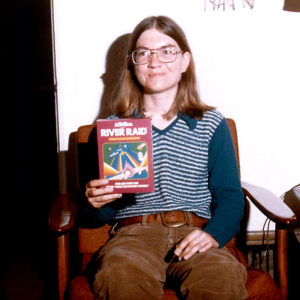
Despite being one of the better looking games on the system, it doesn’t have much complexity. It’s a competent “shooter” but not better than Demon Attack (1982) or River Raid (1982) (which was also programmed by a woman).

While we’re on the Atari 2600, it was inevitable to mention the pornographic video games produced by PlayAround. If these games had any substance to them — like a character with some agency, even if that agency is pursuing sexual gratification — then I would mention them in detail. Alas, they do not.
An important distinction needs to be made: female characters can be sexual. Sexuality is a key part of human identity, but it needs to belong to them and not to their observers. The heroine of Bayonetta (2009) is overtly sexual to the point of parody, so much that it can be found distasteful, but her sexuality is entirely her own and expressed on her terms. This sense of ownership is what makes characters like Morrigan from Darkstalkers: The Night Warriors (1994) broadly popular.
Again, I’m not the authority on that.
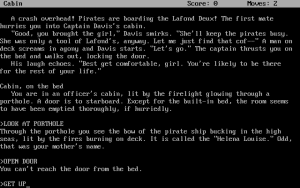

There were so many text adventure games released around this time that it’s hard to tell which to credit first. It’s also hard to discern which ones explicitly include playable women. Worth a mention but I’m going to forego these. I highlighted Plundered Hearts (1987) for its significance.
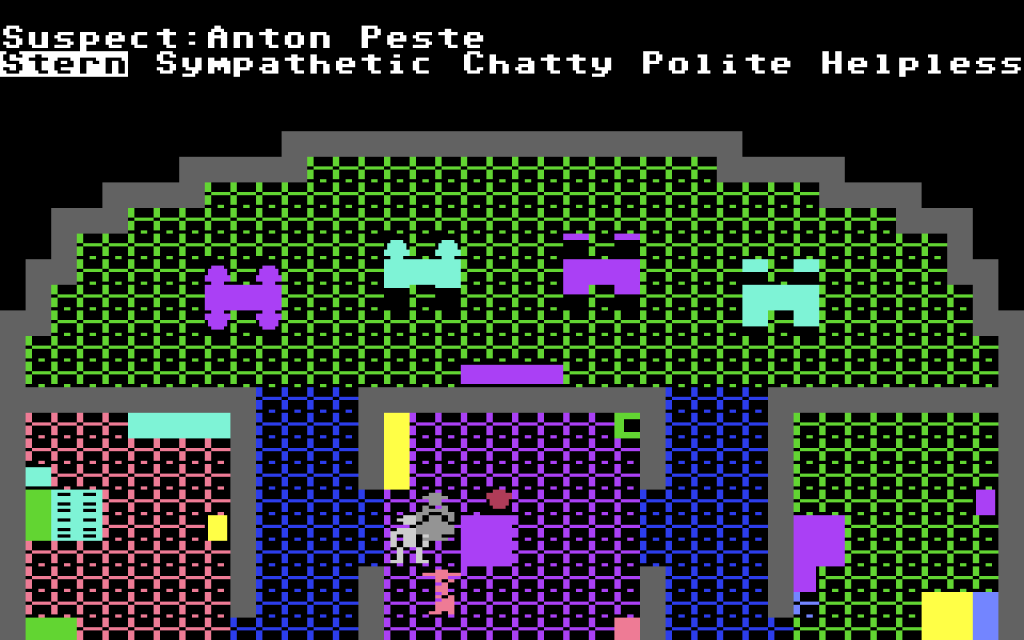
Murder on the Zinderneuf (1983) is an Agatha Christie-style murder mystery with eight detectives, two of which were women — one a parody of Modesty Blaise, the other Miss Marple. They are hardly discernible in-game but still, they count.
There were also a number of female athletes in various sports games. I won’t be mentioning unnamed or generic characters from this point on, but I thought I should say that these characters did exist.


Jenny of the Prairie (1983) was created by Rhiannon Software, a development studio founded by women and had girls in mind as their primary demographic. This is the first in their Adventure Stories for Girls series.
Jenny of the Prairie is no cozy forest stroll, but a challenging wilderness survival game. After being separated from her family, Jenny must find food, clothing and shelter before winter approaches. She can also befriend a fox — that very odd-looking one on the cover.
In spite of her age, Jenny is far from helpless. She is quite proficient at hunting with her spear and slingshot. She can also battle snakes and coyotes with ease. Winter is Jenny’s only true enemy, which doesn’t even announce its arrival on the higher difficulties.
I think Jenny of the Prairie‘s greatest success is that it depicts girls as problem-solvers with initiative. If even one girl who played this game felt inspired by Jenny’s hardiness, then I think Rhiannon Software succeeded in their goal.
I choose to believe that Jenny became The Boss from Metal Gear Solid 3: Snake Eater (2004).

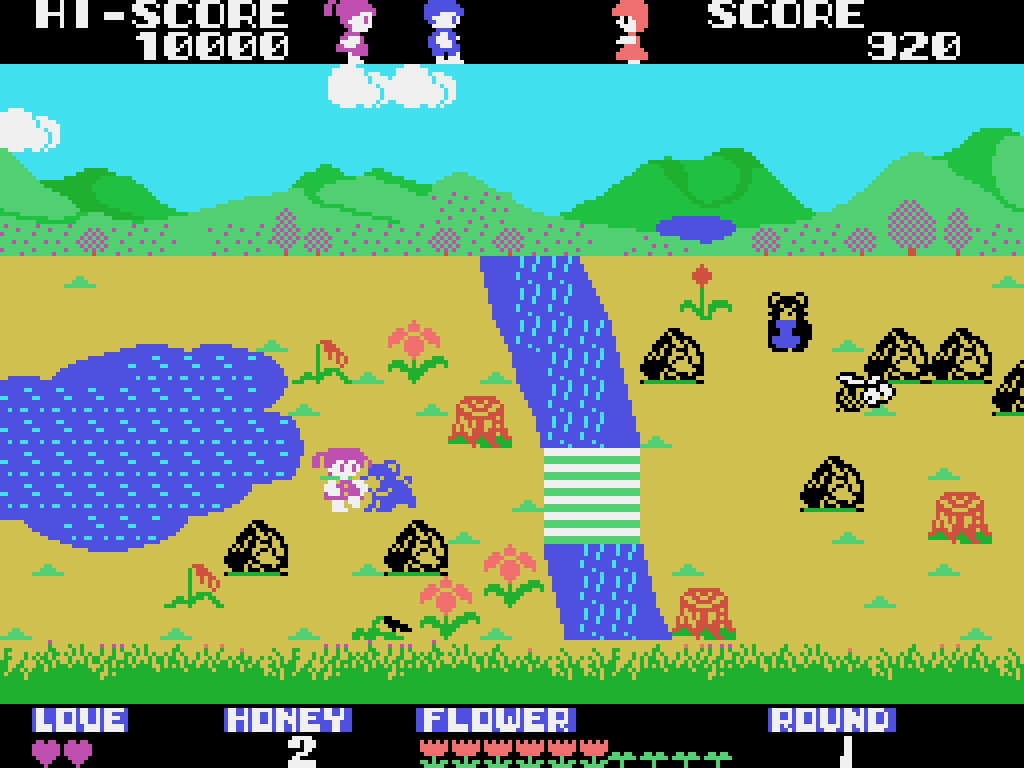
Here we go: the first offering from the land of the rising sun, and by the co-creator of Sonic the Hedgehog (1991), no less. The protagonist here is Papri, who must collect flowers to impress the boy of her dreams before he chooses another girl… wait, what?
Released on the woefully underpowered SG-1000, Girl’s Garden (1984) nonetheless manage to portray its world and characters with a lot of charm. It’s just a shame that the hardware limits its vision, not least of all reflected in its choppy scrolling.
The titular garden is protected by bears, which Papri can distract with jars of honey. Papri can receive honey and other helpful items from Prim, a bee who will also occasionally drop human skulls. What the heck, dude?
The flowers have various stages of growth and are only valuable while in full bloom. Not trampling them before they’ve grown is part of the strategy. The manual describes them as special “love flowers” and this combined with her crush’s inclination towards the other girl makes me think that Papri is the bad one here.
While we’re on the subject of women’s wrongs…


These ladies only care about one thing: beating the snot out of whoever dares to cross them.
Bionic Granny (1984) is about a foul-tempered pensioner who loves beating kids as they try to leave school. The only person bold enough to challenge her is the lollipop lady, whose lollipops can shred through Granny’s cybernetic enhancements.
Cauldron (1985) somehow started life as an adaptation of Halloween (1978), which tells me that the developers only looked at the film’s title. Both a shooter and a platformer, the Witch Queen must collect ingredients to banish a talking pumpkin who she really doesn’t care for.
Women in folklore are usually depicted in one of three archetypes: the maiden, the mother and the crone. Rarely is that last one flattering, but it can serve as a way to subvert traditional gender expectations. So you know what? More power to them.

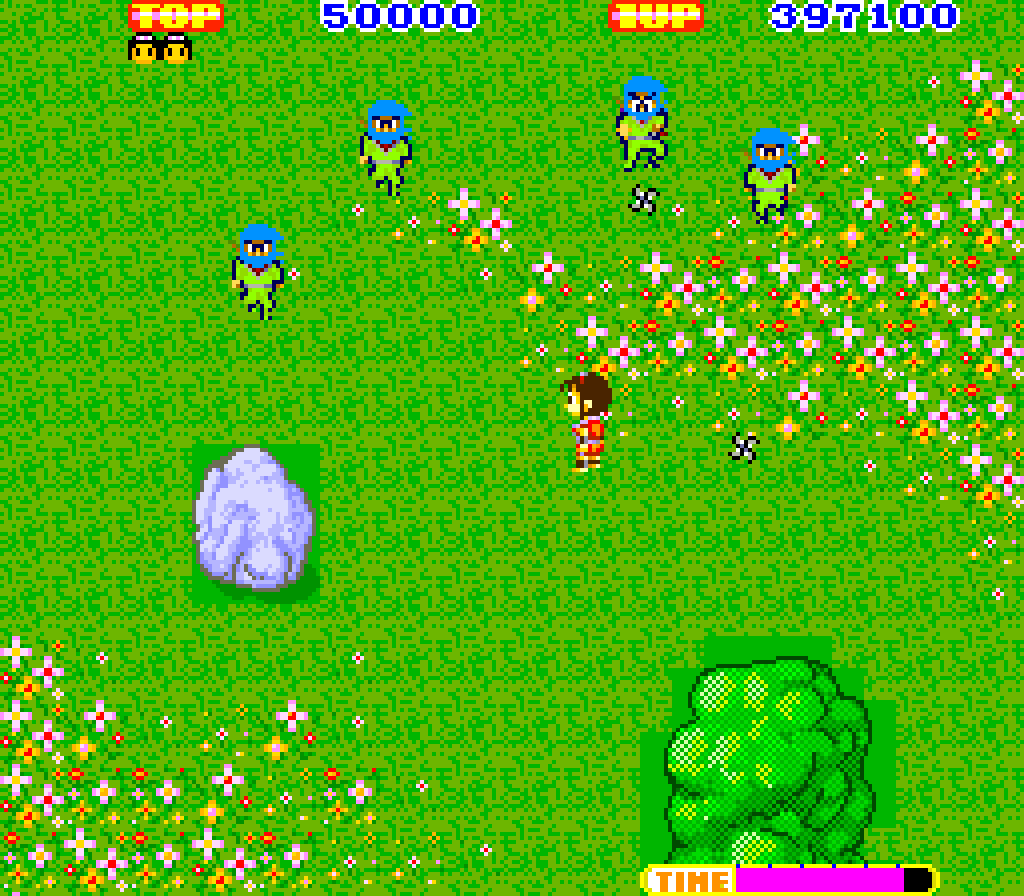
My hero, Rieko “Phoenix” Kodama, the one who made me fall in love with pixel art, definitely had a hand in pushing a female protagonist here. She would do the same for Phantasy Star (1987) too.
Princess Kurumi of Ninja Princess (1985) has quite an ordeal ahead of her: she’s a one-hit wonder who must single-handedly infiltrate a fortress to overthrow a villainous ninja clan. This game is very, very hard.
Perhaps in an effort to make her cute, Kurumi will fall to her knees and cry instead of dying outright. As embarrassing old men like to say, “tears are a woman’s weapon” (女の涙は武器), so maybe this is her last stand? Yeah, no.
Unfortunately for Kurumi, this game’s later ports would remove her entirely, replacing her with a man named Kazamaru. I have a suspicion that this has happened many times throughout history.


Technically two characters, Kissy and Taki from Baraduke (1985) are fully suited, gun-toting space warriors only later revealed to be women. Hey, doesn’t that sound familiar?
The game’s designer was inspired by Nausicaä of the Valley of the Wind (1984) and this is reflected in Kissy’s unmasked design. Despite this, the game’s win screen will call you a “brave man”. Given the root of the word, that is not technically incorrect.
The game’s sequel, Bakutotsu Kijūtei: Baraduke II (1988), presents her with a ponytail and very cool shades during the game’s intermissions. I quite like this look and it’s a shame that her subsequent appearances would make her “cuter”.
She must be loved by someone at Namco because she keeps returning in other games, and was also given a full name, with “Kissy” only being a moniker.


That’s a lot of gals.
By this point, playable women in games were nothing new. Whether that was good representation is up for debate, as this was also a popular time for skimpy bikini armour.
What is certain is that by 1985, we started seeing more female characters designed by men, often with no women beside them to provide feedback. When women started being designed by men for men, we all know what was bound to happen.
A number of games with women as optional playable characters began to appear, such as Atari’s Gauntlet (1985) and Sega’s Quartet (1986). Fantasy worlds were also becoming increasingly popular in the mainstream, which leads us to…


Fantasy worlds! Worlds where magic and superpowers exist! Surely there is no power imbalance to be found in there? Haha, yeah…
SNK’s Athena (1986) starts as another bikini armour character, a trend which I’m sure began with Genmu Senki Reda (1985). However, she is able to clothe herself eventually, not unlike the male protagonist of Wonder Boy: Monster Land (1987).
Namco’s Ki originated in Tower of Druaga (1984) as the damsel in distress. Its sequel, The Return of Ishtar (1986), now gives Ki the leading role, accompanied by her rescuer as a secondary character. She is far more difficult to play as, wielding magic which is exclusive to her, but the game must be played by two people regardless.


Eventually spawning the hugely underrated Valkyrie series, the titular heroine had her humble beginnings in Valkyrie no Bōken: Toki no Kagi Densetsu (1986) or Valkyrie’s Adventure: Legend of the Time Key.
This is an action RPG where your growth is determined your star sign and blood type. If you’re an Aries, Leo or Sagittarius, I’m afraid that you’ll be unable to use magic. Sorry about that.
You can also change the colour of Valkyrie’s clothes and she even has a little house to visit! This whole adventure feels very personal, doesn’t it?
The game plays like a marriage of Hydlide (1984) and The Legend of Zelda (1986), merging the rhythm of the former with the action of the latter. As ambitious as it is, it does have the expected “old game jank”.
Its immediate sequel, Valkyrie no Densetsu (1989), is bloody brilliant though. Check it out.


And we’re going to end this with the character who many people erroneously believe is the first woman in gaming: Samus Aran from Metroid (1986).
Most gamers already know the story: her gender is kept a secret unless you’ve beaten the game in under 5 hours, whereupon she’ll remove her helmet… and if you’re very fast, everything else too.
This decision was made late in development, with Samus being considered a robot before that point. The game’s title is even a contraction of “Metro Android” in reference to its level design and protagonist.
Despite being known far and as wide one of gaming’s most resilient warrior women, Samus has struggled with unnecessary sexualisation and poor character writing since day one. Her creator, Yoshio Sakamoto, seems unable to enter a woman’s headspace to write her convincingly. None of this is helped by the popularity of her “Zero Suit” design, where she looks more like a supermodel than a bounty hunter.
That said, Samus’s highs are very high, and her games never fail to be entertaining… well, except that one.


We’ve come a long way since the 80’s. Characters like Alyx from Half-Life 2 (2004), Clementine from The Walking Dead (2012) and Hinako from Silent Hill f (2025) are written with consistent integrity throughout their adventures, reminding us that genuine equality begins with portraying them as whole, human characters.
None of this would have been possible without the efforts of women in the gaming industry, providing their invaluable insight to create characters which truly reflect the people they are supposed to depict.
Here’s to those pixel pioneers who helped helped pave the way, both on-screen and off-screen. Thank you for telling your stories.