


Welcome to Mixed Bag, a feature for games which don’t deserve full length articles.
The Sega My Card was a line of credit-card-sized game cartridges released for the SG-1000, Mark III and Master System. They were the invention of Hideki Sato, who designed all of Sega’s consoles and felt that chunky game cartridges were an eyesore.
Holding only 32KB of space, the games were usually very simple and sold for a reduced price. They are not dissimilar to the MSX’s Bee Cards.

Most of the games were very compromised ports of arcade or MSX games, but it did see a number of original titles. Today, we’ll be looking at a few of those. I’ll be skipping the Championship sports series because I don’t find them very remarkable — sorry, sports fans.
Dragon Wang (1985)


Tee hee, funny name. Dragon Wang is very similar to Irem’s Spartan X (1984), mechanically and structurally, although you can only kick.
You must ascend a tower with a unique boss on each floor — a martial arts trope which popularised by Game of Death (1978). It begins with three floors and clearing it sends you to a new tower with an additional floor, up to a maxium of six floors. After that, it loops forever.
When you save(?) your girlfriend(?) after each round, the game declares “Only with true love can you become her hero!”, like “don’t come back until you’ve beaten the robot on the fourth floor, you bum.” Yeah, there’s a robot. There’s also a disembodied pair of legs. His name is Jonathan.
It would have a spiritual sequel in Kung-Fu Kid (1987). It has jiangshi enemies like Encounters of the Spooky Kind (1980) or Mr. Vampire (1985); I love those silly guys.
Pit Pot (1985)

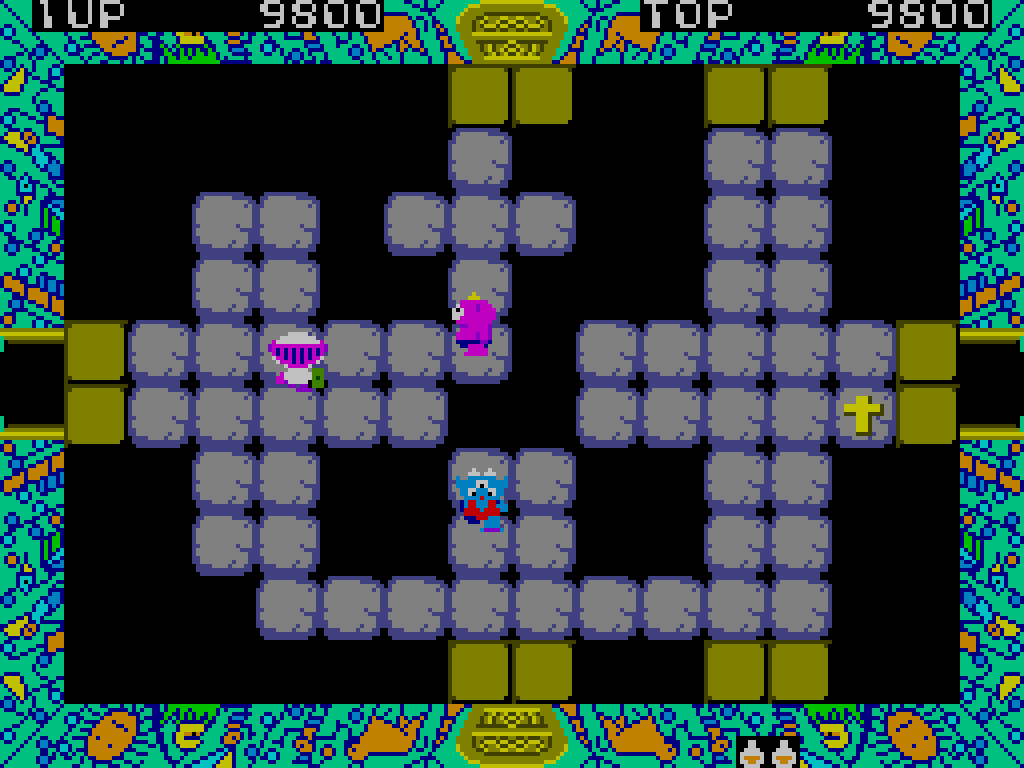
What if you and your weird witch girlfriend role-played her turning into a princess waiting to be rescued by someone with a hammer and a bunch of trash? I’ve probably misread the story.
This is a top-down game where the middle of each floor contains breakable tiles. The tiles will regenerate after a while, so you’re free to go ham(mer) on them.
I’ve never quite been able to grasp the logic behind by this game: your hammer can destroy enemies and avoiding them isn’t hard, so what’s the point in the floor mechanic?
There is a level editor mode but it’s woefully primitive, not even letting you choose your starting position or edit any adjacent rooms. The most interesting thing I can say is that your character’s death animation resembles the one from Alex Kidd in Miracle World (1986) — another game with a few curious design choices.
This was later packaged with Astro Warrior (1986) and released as a standard cartridge. Neither game is very good but Astro Warrior is perhaps ever-so-slightly better.
Satellite 7 (1985)


This is a shoot-’em-up with a bomb attack which you can use to target land-based enemies, a la Xevious (1983). Unlike Xevious, there is no indicator to tell you where the bomb will land, but you get used to it.
The environments repeat themselves and there’s only one recurring boss fight, but it’s a fairly frantic shooter with some decent enemy variety. It has a simultaneous two-player mode, which is pretty cool.
The power-up system is quite unique: you collect coloured stars and after amassing a number of them, you receive a momentary power-up. I’m not a huge shmup fan so maybe that’s been done before, but I like the idea of filling a gauge for your abilities.
It has an FAQ by Ice Queen Zero 🔗, a legendary retro game enthusiast whose family has been covering games for a very, very long time. She could probably tell you a lot more about it than me.
Comical Machine Gun Joe (1986)


This game feels like the devs just made stuff up and kept whatever stuck. Shooting enemies turns them into baby versions of themselves, who slow you down by clinging to you, and you can also use them as human shields? Okay.
You can fire in five different directions (forward, sideways and diagonally). You can jump to momentarily avoid enemy fire, although it’s not terribly reliable, and shoot a pig to receive a screen-clearing orb. Words, I have none.
This game predates Cabal (1988), which went on to define this perspective and gameplay style. The game’s designer, Mutsuhiro Fujii, also directed Space Harrier (1985) and Fantasy Zone (1986), so he clearly has a penchant for the bizarre.
Comical Machine Gun Joe, or just Machine Gun Joe on the title screen, is a very hard game. Enemy bullets always aim at your current position and you have a mere few seconds before they react. Bosses will fire several of these in a row, and it’s not easy to aim and dodge at the same time.
After vaporising a gun-wielding schoolgirl and shooting up a cemetery, I’m not so sure that Joe has a heroic motive. That’s fine; Laharl agrees that the world could use more villain protagonists.
Woody Pop (1987)

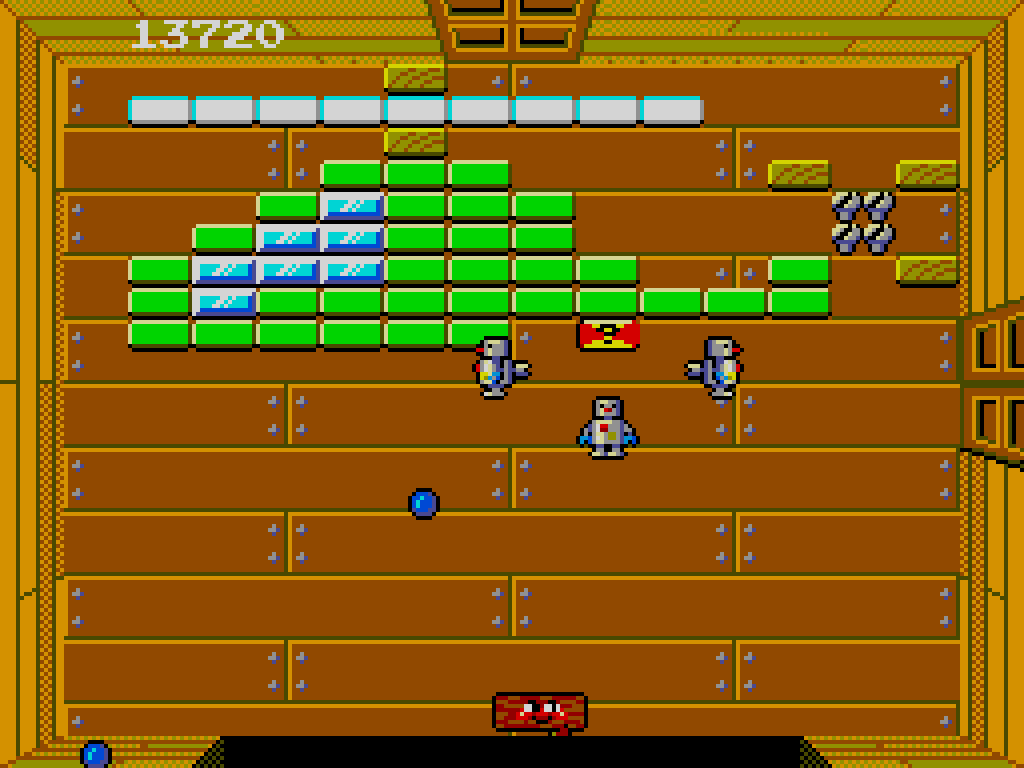
This is a Breakout (1976) clone with a unique aesthetic: everything is made of wood. Really? Not candy or something aesthetically pleasing? Nope, wood. Just plain wood. That’s what the players yearn for.
This is actually very competently made. Certain blocks will release enemies and power-ups, which add a lot of variety — lighting up scores of wooden blocks with a firey ball is never not fun. You can also choose a path through the world and it’s fun to see all the unique stage patterns.
This is how you create a simple game: a strong foundation, a few things to add variance, and a charming look and feel. The designer was Kotaro Hayashida, who has several impressive credits to his name.
This is one of the few games to support the Mark III paddle controller. In fact, I think the Japanese release uses this controller exclusively.
The Black Onyx (1987)
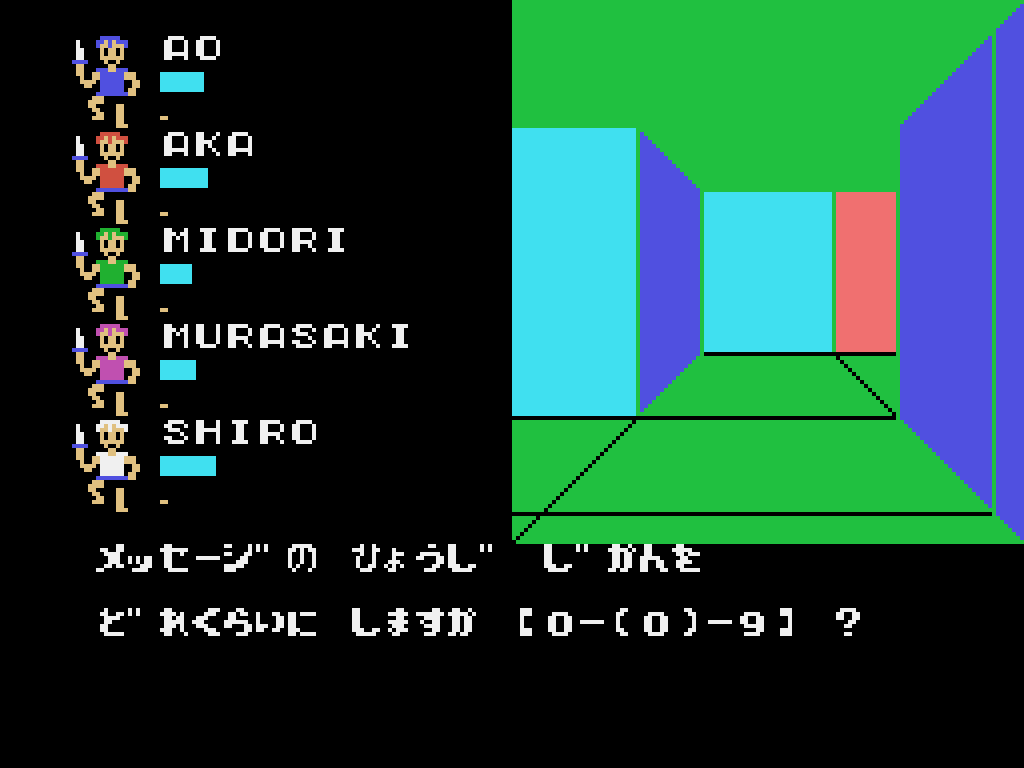

Surprise — I broke the “no ports” rule. I’m covering this one for its historical value, as either this or Mugen no Shinzou (1984) is the first original RPG to release in Japan. It was designed by Henk Rogers, owner of the Tetris (1985) trademark, but programmed by Eiji Kure. It arrived three years after its initial release on the PC-8801 home computer.
To say it was influential was an understatement: it’s been quoted by Hydlide (1984)‘s Tokohiro Naito and The Legend of Zelda (1986)‘s Shigeru Miyamoto as an inspiration for both. Henk saw the popularity of Wizardry: Proving Grounds of the Mad Overlord (1981) and wanted to create a digestible version for the Japanese market.
It’s a little too digestible though, as every character has no unique skills to distinguish them. This means that there is effectively no combat strategy. You also can’t check your stats without visiting a hospital. Thankfully, progression is relatively fast, so none of this matters much… it’s just not very fun, sadly.
It should also be mentioned that the My Card version was released three years after its original version. By this point, there were a plethora of superior games available. Phantasy Star (1987) would arrive later that year, firmly planting this already outdated game in the ground.
An unfair comparison but I’ve seen modern indie RPGs which heavily truncate the RPG experience far more successfully than The Black Onyx did. This is still a charming novelty and worth checking out; just temper your expectations.
That’s all we’ve got in the bag for today. See you next time!