


Why are there so few truly good Lovecraftian games? Seriously, I can count them on one hand. Is it because the impossible geometry and unknowable rules of alien gods don’t translate well to a medium limited to sight and sound? No, that can’t be it. After all, you can always adapt the horror to fit the format, and that leads us to…


Actually, no, it doesn’t bring us to Alone in the Dark. According to lead programmer Frédérick Raynal, the Lovecraftian elements were added only as a bit of flavour. Which is odd, considering the entire project began after Infogrames acquired the license to Call of Cthulhu (1981).
Raynal cited George Romero and Dario Argento as his inspirations, but the tone lands closer to Roger Corman. Even so, the box confidently proclaims it “A Virtual Adventure Game Inspired by the Work of H.P. Lovecraft”. I don’t think he’d have been pleased anyway since one of the protagonists looks a bit Irish.


The story unfolds in Derceto, a Louisiana mansion and the former abode of Jeremy Hartwood, who recently took his own life. No one seems particularly shocked, given Derceto’s long-standing reputation for the uncanny. You can choose to play as his niece, Emily, or private dick Edward “The Reptile” Carnby, each drawn to the house for their own reasons.
This choice is purely cosmetic as Emily and Edward play identically. I’m partial to Edward’s dapper low-poly moustache and perpetually disgruntled expression, but the adventure and its ending plays out the same either way.


Originally conceived by its producer as a game where you’d strike matches to briefly illuminate the darkness, Raynal instead pitched a full 3D adventure — and ended up building the engine on his own time to prove it. It’s good for us that he did, as Alone in the Dark would inspire countless other works, not least of all Capcom’s Resident Evil (1996).
Of course, a fully 3D adventure was far beyond what computers of the time could handle. The admittedly primitive 3D character models were paired with beautifully rendered background art, all created by Yaël Barroz. That blend is what gave the game its unmistakable look: something suspended between the worlds of 2D and 3D.
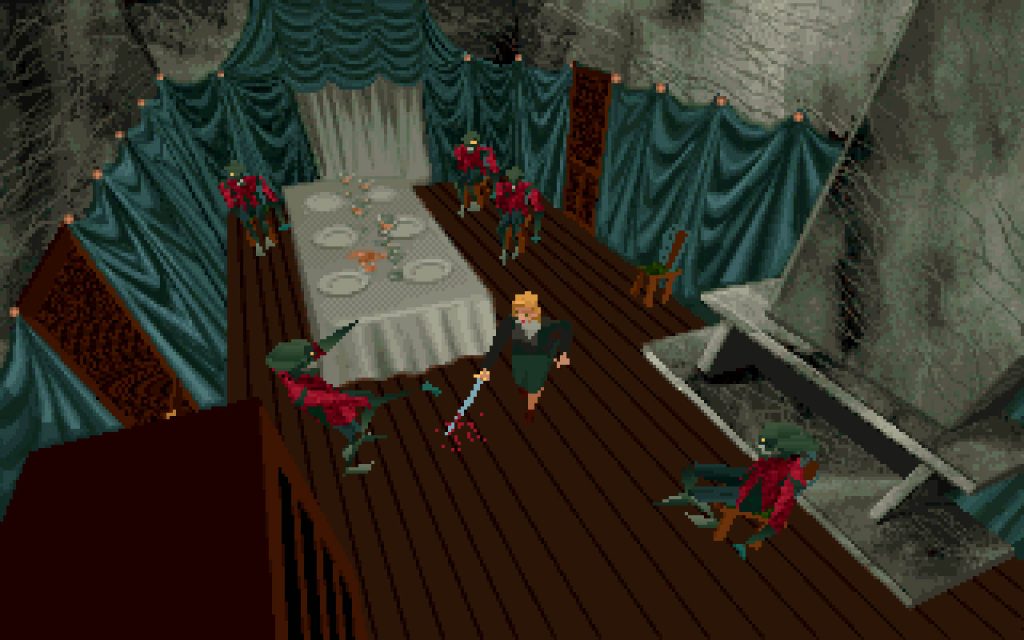
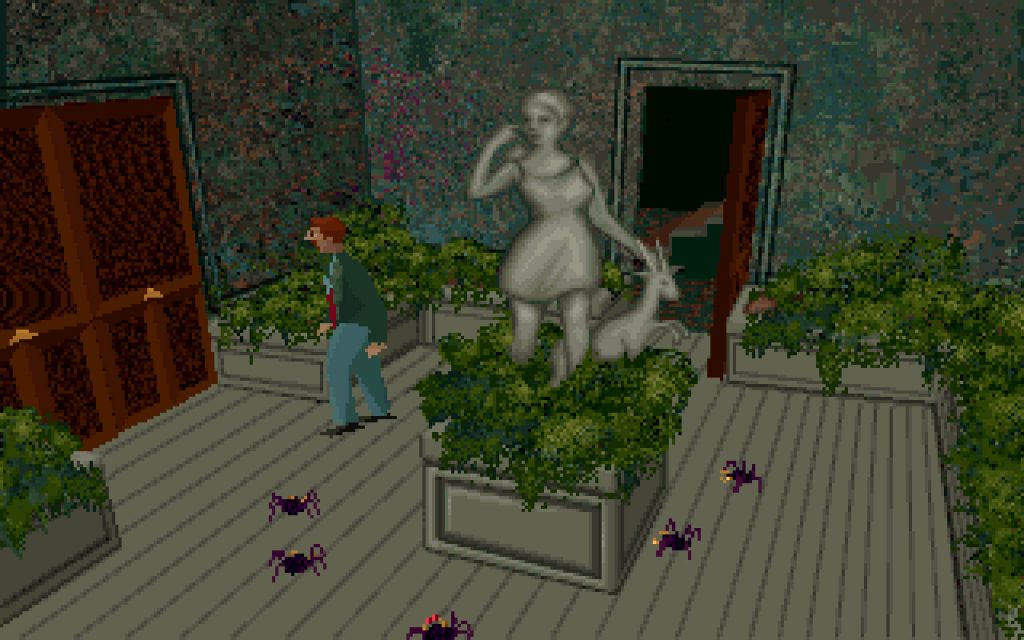

Movement is handled through tank controls, with a very fickle ability to sprint by double-tapping forward. You can hold an action button to enter a particular “mode”, such as searching or fighting. These modes must be assigned from a menu, which feels odd. It would’ve been more convenient if they were directly mapped to buttons.
The menu displays your inventory, complete with a 3D model for every item. That may seem unremarkable today but at the time, this was a phenomenal amount of work, and the developers deserve credit for it. Sadly, there is a limited inventory, so habitual hoarders will find themselves distressed.


There’s plenty of object-based puzzle solving, as you’d expect from a game of its era. Fortunately, the puzzles aren’t as difficult as those of its contemporaries, and most players will work them out with a bit of patience. However, it is possible to throw key items into unrecoverable places.
The horror element is handled well. Enemy encounters rarely repeat, with most foes appearing only in one room and requiring a specific strategy to defeat. This unpredictability lends the game a good deal of tension — and “unpredictable” is exactly the right word, as enemies often emerge in surprising ways. That window scare in Resident Evil? It happened here first.


Although the game ultimately evolved far beyond its original concept, a few sections still require you to navigate in complete darkness. Your character even remarks, “This room is in the dark!”. Fortunately, these moments are brief, and the game more than compensates with strong set pieces and a genuinely exciting finale.


Interestingly, no later game followed the exact same template. After Alone in the Dark came Jack in the Dark (1993), a playable teaser for the sequel, which puts you in the shoes of a little girl exploring a haunted toy shop.
Alone in the Dark 2 (1993) then tasks you with rescuing her. Set a months earlier, this game trades Cthulhu for voodoo and tommy guns. Emily is absent this time, leaving Edward as the sole protagonist. Sadly, his magnificent moustache did not make the transition.


Alone in the Dark 3 (1995) is set in a literal Western ghost town. Horror Westerns are such an underused subgenre and this game leans into it wonderfully. Emily does return as a secondary character, though her role is quite limited. Still, it’s nice to see her again, even though it portrays her as Edward’s old friend when the series never actually established that the two had ever met.
Despite being the weakest of the original trilogy, Alone in the Dark 2 was ported to the 3DO, Saturn, and PlayStation, complete with fully textured models and FMV cutscenes.


The shifting tones may well stem from the fact that Frédérick Raynal only worked on the first game. That brings us to the end of the original series, though it’s still worth mentioning a couple of the later entries.
As Alone in the Dark inspired Resident Evil, it was now Alone in the Dark‘s turn to be inspired. The new millennium brought us Alone in the Dark: The New Nightmare (2001), a perfectly serviceable instalment that nevertheless feels very much like a product of its time — not least because of its 90’s comic book aesthetic.

Unfortunately, this marks the beginning of a troubling pattern: Alone in the Dark becoming a parody of its own legacy. Not intentionally, mind you, but every developer that has taken on the series seems convinced that it must rigidly follow the survival horror conventions it once helped to establish.
It feels like the sort of decision only a boardroom could make, one with little sense of history or genuine creativity. Nowhere is this more evident than Alone in the Dark (2024), a profoundly uninspired remake of the original game.


If you want to find Alone in the Dark‘s pioneering spirit nowadays, you won’t find it from big budget studios who attach pre-order incentives to their games. I would argue that indie titles like Fear the Spotlight (2024) and Heartworm (2025) are the true torch bearers of the series, with Alone in the Dark‘s named sequels only wearing its skin.
